
Scarcity doesn't pay
Careers were built on becoming singular. That arrangement had a condition nobody wrote down.

A few days after Mare of Easttown started airing in 2021, an interviewer asked Kate Winslet what her executive producer credit had actually got her. That question normally gets a warm non-answer. She answered it.
The credit gave her, she said, “a creative voice in a really collaborative way when it came to story, when it came to things that either worked or didn’t work, and when it came to cuts, script changes that were made and the casting of actors.”
Story. Cut. Script. Casting. Four named levers, in writing, on the one production where she was also the reason anyone tuned in.
Now here’s the same problem from our side of the industry.
SCENE ONE
A staff engineer sits down for a calibration conversation. Her throughput is up. So is everyone’s. Her manager, who likes her, says the thing managers are saying this year, which is that it’s become hard to distinguish individual contribution from the tooling.
What she actually did last quarter was kill three approaches before anyone else saw them. One would have coupled the pricing service to the catalogue in a way that would have surfaced eighteen months later as a migration nobody could fund. She knew that because she’d lived through the previous version of it in 2021.
There is no artifact for any of that. The commits she has to show are the ones for the approach that survived, and those look exactly like commits a model could have produced, because increasingly they are.
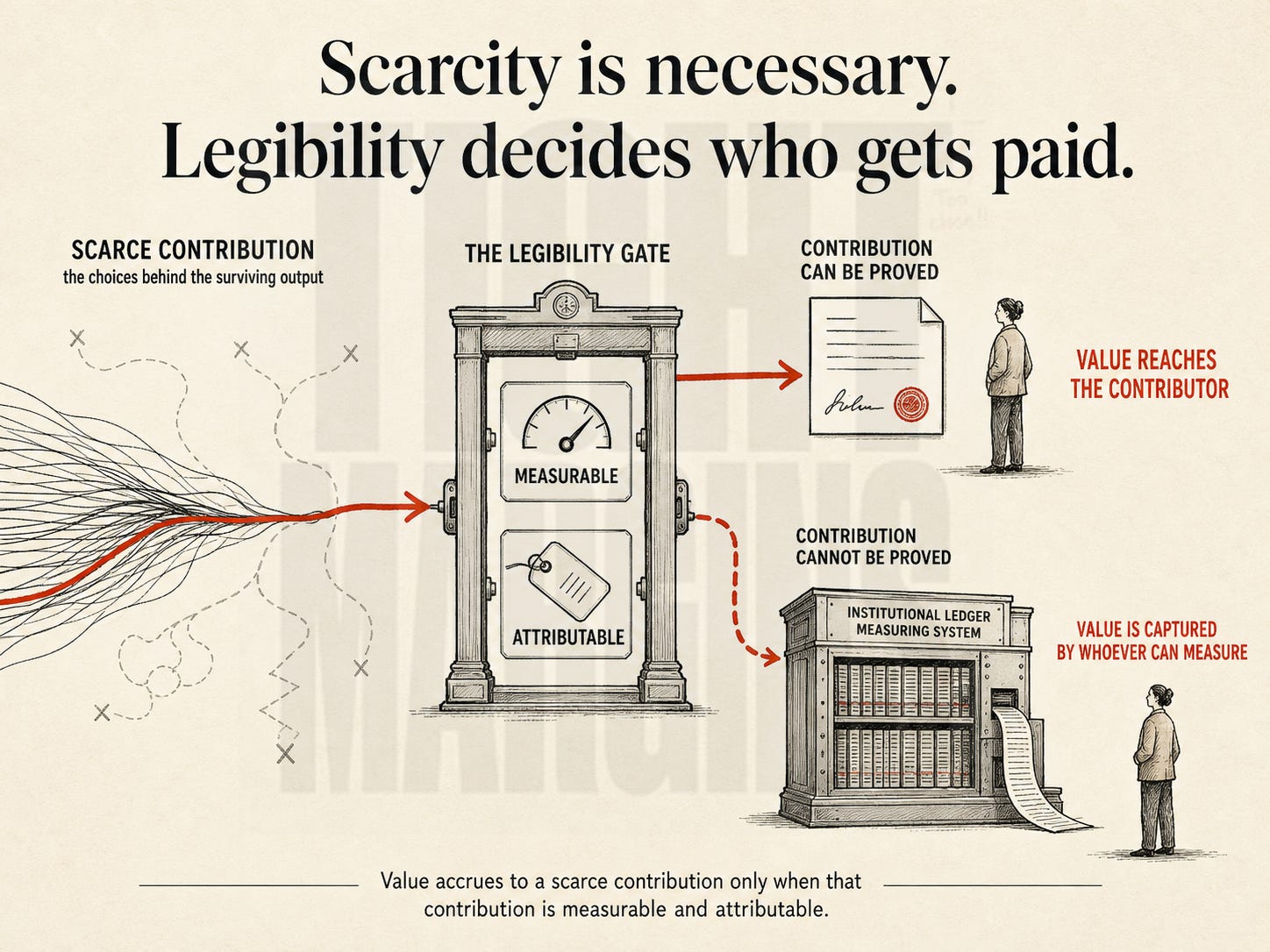
She’s scarce. She can’t prove it. That gap is the whole subject here, and it’s the thing the current wave of strategy writing keeps stepping over.
The worries I keep hearing from people in product and engineering right now come in a short list. Am I about to get levelled down. Is the PM to engineer ratio about to change. Do I need to be shipping code myself now. What do I say in a review when my output looks like everyone else’s. Is “AI PM” a real job or a trap. How do I sign off on a feature that behaves differently every time I run it.
Four of those six have the same underlying answer, and it isn’t a career-advice answer. It’s an argument about measurement.
Choudary is right about the constraint
Sangeet Paul Choudary published a piece last week making an argument (with streaming media) I’d been circling for a month, and making it better than I had it. Every generation of strategy organises around whatever is scarce. Bottlenecks migrate. Industries die not by failing to adopt a technology but by continuing to optimise a game built around managing something that just became abundant.
His reading of streaming is the sharpest I’ve seen. The common version says Netflix made content abundant. Choudary says the scarcity that actually died was the prime-time slot, and that this moves the viability threshold. A show no longer had to pull fifteen million people on a Thursday. It could earn its keep with a small, specific audience over a long time, which is why the darker and narrower and weirder projects suddenly got funded, and why Squid Game became globally important without ever being designed as global television.
Better mechanism than the one I’d been using, so I rebuilt on it. Hollywood misread streaming as a new pipe for the same product, and the misreading wasn’t stupidity. It was the ordinary error of asking how the new thing improves the existing game.
Then he runs the move on AI. The bottleneck that dies is the cost of exploration. Serious analysis used to need scarce expert time, so organisations rationed which questions got investigated before knowing which ones mattered. He walks three candidates for the new scarcity, dismisses one, and lands on a fourth thing: the scarce asset is the learning architecture, the system that frames a search space, floods it, kills the weak candidates cheaply, tests the survivors, and works out where irreversible commitment is warranted.
I think that’s correct. It’s also a claim about firms, and it leaves a hole exactly where most of his readers work.
Where value moves is a different question from who catches it
Choudary says power shifted from networks, who controlled distribution, to talent, who became scarce because platforms needed enormous volumes of differentiated content. Individuals get about one sentence in his piece. Bobby Deol and Winona Ryder, careers transformed, moving on.
Talent did become scarcer on his own account. And most talent did worse.
Take the boom years on their own, before any strike gets near the numbers. Between 2018 and 2022 the count of scripted originals went from 495 to about 600. Over the same five years the number of Writers Guild West members reporting any earnings at all rose 6.4%, and their total earnings rose 13.5% in nominal terms, which against inflation was a fall of 2.6%. Per working writer it was worse.
Demand for the thing they made grew by a fifth. Every one of them was worse off at the end of it than at the start.
The composition data says it again from inside. The Guild’s own analysis found the share of television writers working at contract minimum went from 33% in 2013 to 2014 up to 49% in 2021 to 2022, and among showrunners, the top of the craft, from 2% to 24%. Both windows close before the strike as well.
What happened next is the part everyone quotes and the part I’d handle carefully. Earnings fell to $1.29 billion in 2023 and writers reporting earnings dropped to 5,501, a fifth of the profession in twelve months. But the Guild struck for 148 days that year, and its own report attributes the fall to the contraction and the strike together without separating them, so anyone who wants to dismiss that number can. The one they can’t dismiss is 2024, when nobody was striking. Employment fell a further 9.4%, landing roughly a quarter below 2022, while earnings recovered to $1.5 billion. The money came back before the work did, and the work has not.
The bottleneck migrated toward talent and the median talent got poorer, during the boom, before the strike, and after it. That’s not a rounding error in the theory, it’s a missing condition.
THE CONDITION
Value accrues to whoever holds the new bottleneck only to the degree that contribution at that bottleneck is measurable and attributable. Where it isn’t, the bottleneck holder gets squeezed anyway, by whoever can measure.
Call it the legibility condition. Scarcity is necessary and nowhere near sufficient. You also have to be able to prove, to the party writing the cheque, that the scarce thing was yours. Which is the staff engineer’s problem in scene one, stated as economics.
Two things broke, and only one gets discussed
My first instinct about actors in the streaming era was that they must be working more to earn what they used to. It feels true and it’s mechanically wrong.
They probably need to work longer hours now to make the same money and keep the same stardom going.
The annuity went first. Residuals date from 1960 and paid out every time something re-aired or got re-sold, so a working writer accumulated a stock of assets that threw off income for a decade with no further labour attached. Netflix built a different machine: pay the budget plus a premium up front, own the thing outright, no backend. Sarandos was still defending it in late 2024 as a kindness. Domestic syndication residuals collected by WGA West fell from $37.8 million in 2019 to $17.6 million in fiscal 2023, though the number the strike coverage skipped is that total WGA residuals rose over the same stretch, to $598.5 million, because new media reuse more than covered the collapse. The pool got bigger. The individual title stopped being an asset. Income moved from a stock you owned to a flow you had to keep generating.
Then the scoreboard went, and this is the one that matters. Box office was a public number with a name attached. Streaming numbers were private, and the asymmetry did enormous work at the table. A talent lawyer described the loop in 2021: client says my show was a hit, streamer says we have something else that did better, conversation over. Soderbergh was blunter. “They will not open the books, so how do you figure out what’s fair if you don’t know what’s going on?”
Ten years of talent being structurally scarce and structurally unable to demonstrate it. That’s the whole explanation for why the migration Choudary describes ended on a picket line rather than in the money.
And notice what the 2023 strikes were actually about, because it’s the tell. Not only rates. Transparency. What came back was studios handing streaming hours to the Guild under a confidentiality agreement, shareable with members only in aggregate. Not public. The viewership bonus needs 20% of a service’s domestic subscribers inside ninety days, and as of early 2025 a handful of titles had ever cleared it. A real floor, a narrow one, bought with 148 days of not working.
One more feature of that evidence, which took a while to notice and then wouldn’t leave. Every number above is a writers’ number. The actors’ union publishes no equivalent report, and neither do the directors. The Producers Guild publishes nothing at all, because it isn’t a union: it’s a trade association that has stated plainly it does not engage in collective bargaining, which is why producers have no minimum, no residual and no floor of any kind. Writers dominate this argument not because they were hit hardest but because they were the only ones keeping score. The crafts that couldn’t measure their own contribution also can’t now prove what was done to them, which is the same condition operating one level up, on the historical record itself.
Four rungs, and only two of them are available to you
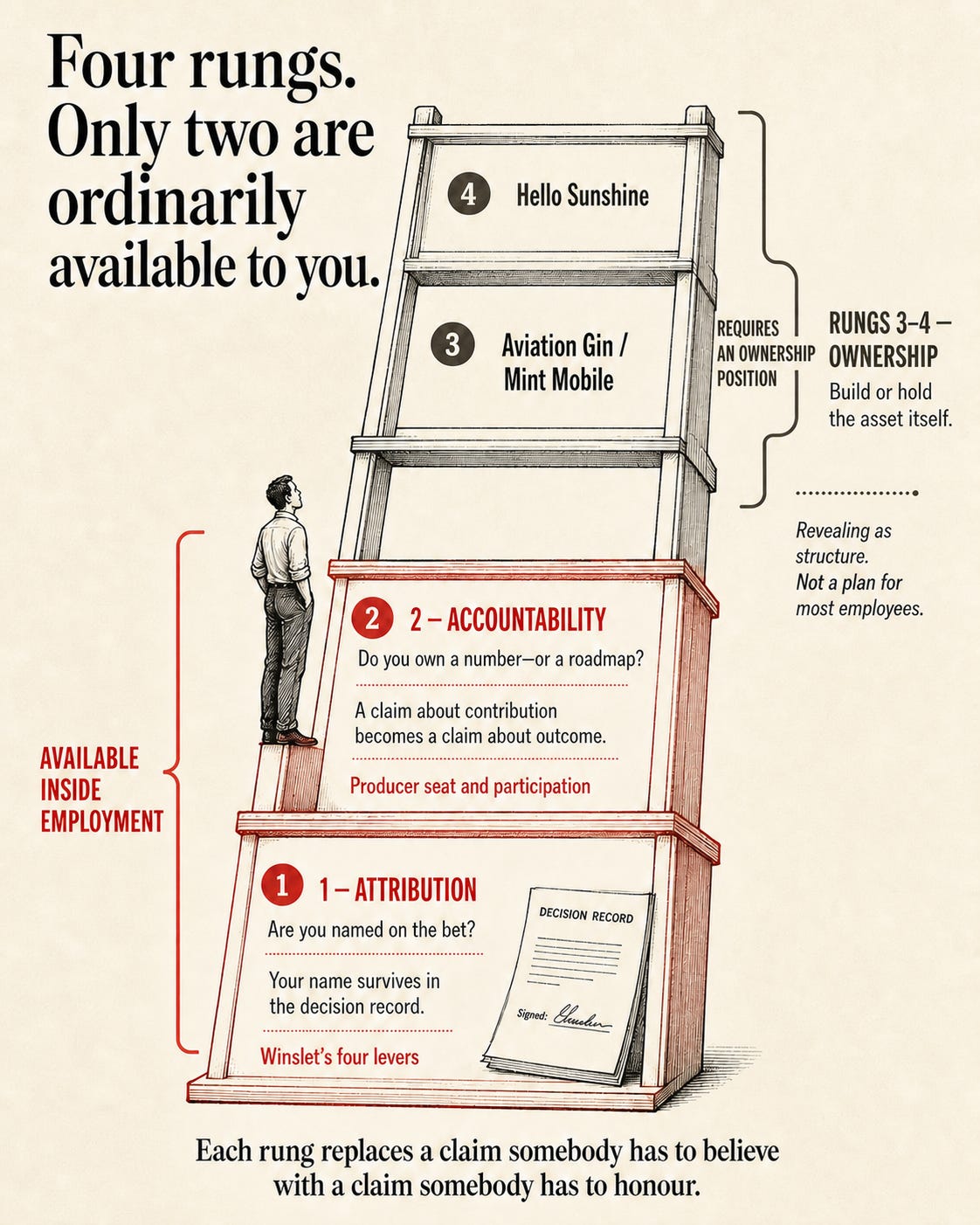
The people who came out ahead in Hollywood stopped trying to get paid for a contribution nobody would measure, and bought positions where measurement wasn’t required. Here’s the ladder, in your terms rather than theirs,
RUNG ONE, ATTRIBUTION Are you named on the bet, or only on the delivery? Winslet’s four levers are this rung: not a share of the profits, just a contractual record that these decisions were hers. In your world it’s being the person the decision memo is authored by rather than the person thanked in it, and being named in the artifact that survives the quarter. Costs nothing. Worth an absurd amount in a market where forty people decide whether to hire you, and almost nobody asks for it because asking feels grabby.
RUNG TWO, ACCOUNTABILITY Do you own a number, or a roadmap? This is the rung that actually changes your life and it’s the one people avoid, because owning a number means the number gets to be bad in public. Margot Robbie’s producer seat on Barbie is the same move: it converted an unmeasurable claim about contribution into a contractual one about outcome. Reported near $50 million, which is not the point. The point is that participation replaced credit.
RUNGS THREE AND FOUR, OWNERSHIP Witherspoon founded Hello Sunshine in 2016 and sold it in 2021 at a reported $900 million, keeping at least 18% and a board seat. Reynolds sold Aviation Gin to Diageo for up to $610 million and Mint Mobile to T-Mobile for up to $1.35 billion. Interesting, and not a plan. Almost nobody reading this is going to leave and build an asset, and pretending otherwise is how career essays waste your time. What these rungs are useful for is the shape they reveal, which is that every one of them replaces a claim somebody has to believe with a claim somebody has to honour.
Then the fact I went looking for something else and found instead, which is the single most useful thing in this whole reference class.
Executive producer credits per film have more than doubled since 2000. Over the same stretch the studio-funded producer deals that used to sit underneath those credits contracted hard, from roughly 900 positions at the 2018 to 2019 peak to about 550 by 2026, television deals down more than half.
The badge inflated exactly as the substance behind it drained away. Which is the legibility condition eating its own tail: a signal that gets cheap to hand out stops carrying information about anybody.
SCENE TWO
A group PM gets offered Head of AI Enablement. New title, visible remit, mentioned by name in an all-hands. She asks three questions in the follow-up, which is two more than most people ask.
Does it come with headcount. No, it’s a matrixed role. Does it come with spend authority. There’s a central budget, she’d be an input to it. Is there a number she owns. The platform metrics stay with the platform director.
So: a title, no levers, and accountability for an outcome she can’t move. That’s an EP credit in 2026 rather than 2004. The correct answer isn’t no, it’s to negotiate rung two before saying yes, and the reason people don’t is that the title already feels like winning.
What crosses over into our situation
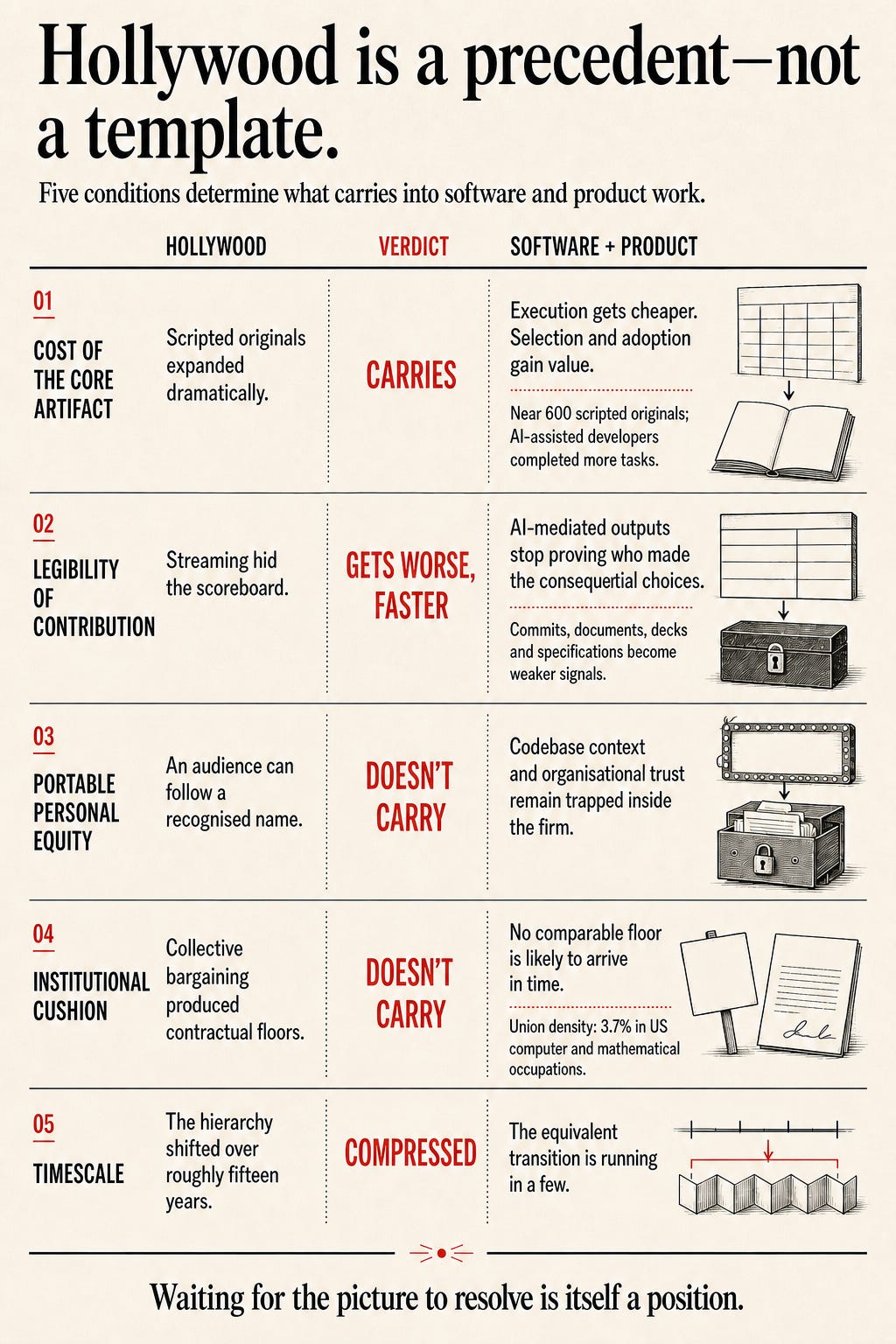
COST COLLAPSE IN THE CORE ARTIFACT. CARRIES.
Film went from 182 adult scripted originals in 2002 to near 600 in 2022. Software’s running the same curve faster: three randomised trials across Microsoft, Accenture and a Fortune 100 firm, 4,867 developers between them, found a 26% lift in completed tasks with an AI assistant. Value migrates upstream to selection and downstream to adoption, the middle compresses. Highest-confidence claim here, and it’s Choudary’s, not mine.LEGIBILITY OF CONTRIBUTION. GETS WORSE, FASTER.
Our situation is uglier than Hollywood’s on exactly the axis that matters. When output volume explodes and a machine sits between the person and the artifact, attribution degrades for everyone at once. Commits, documents, decks and specs all stop being evidence of the thing they used to be evidence of, which is scene one. Expect the squeeze the writers took, arriving sooner, and expect the fights to be about measurement before they’re about money.PORTABLE PERSONAL EQUITY. DOESN’T CARRY.
An actor’s audience follows the name across formats, which is the entire reason format-crossing works for them. Your capital is codebase context, organisational trust, knowing which VP will actually fund something and which one nods warmly and forgets. Real capital, almost none of it portable, and it’s the input the strategy essays assume you already have.INSTITUTIONAL CUSHION. DOESN’T CARRY.
Writers struck for 148 days and came back holding contract language: AI output can’t be treated as literary or source material, studios must disclose AI-generated material handed to a writer, AI can’t be used to cut a writer’s pay. Union density in US computer and mathematical occupations is 3.7%. The Alphabet Workers Union has around 800 members against roughly 130,000 employees and can’t bargain collectively. No floor is coming on a timescale that helps you.TIMESCALE. COMPRESSED.
Film took fifteen years to flip its hierarchy. Ours is running in a few, which removes the option most people are quietly exercising, which is to wait until the picture resolves. In film, nearly everyone who repositioned well was already established when the shock hit.
On judgment, he’s half right, and the half matters
Choudary considers the argument that judgment becomes the scarce thing and dismisses it. His reasoning: this traps you in tired claims about human exceptionalism, since a model can rank options, criticise them, run adversarial checks, compare against evidence and learn which recommendations worked. Betting on human judgment is the error the prompt engineers of 2024 made. An inefficiency arbitrage dressed as a moat.
He’s right about one kind of judgment and wrong about another, and the difference isn’t cognitive.
Epistemic judgment is working out which of these hypotheses is more likely true. He’s correct that it’s being automated and that betting a career on out-reasoning the machine has a visible expiry date.
Accountable judgment is committing in public with your name on it and eating the loss when it’s wrong. A model produces the ranked list. It cannot be the party that’s liable. Firms don’t only need the best-ranked option, they need someone who can be held to it, which is a fact about how organisations and contracts and law are built rather than a fact about cognition. Nothing about better models dissolves it, because the demand isn’t for correctness. It’s for a name on the decision.
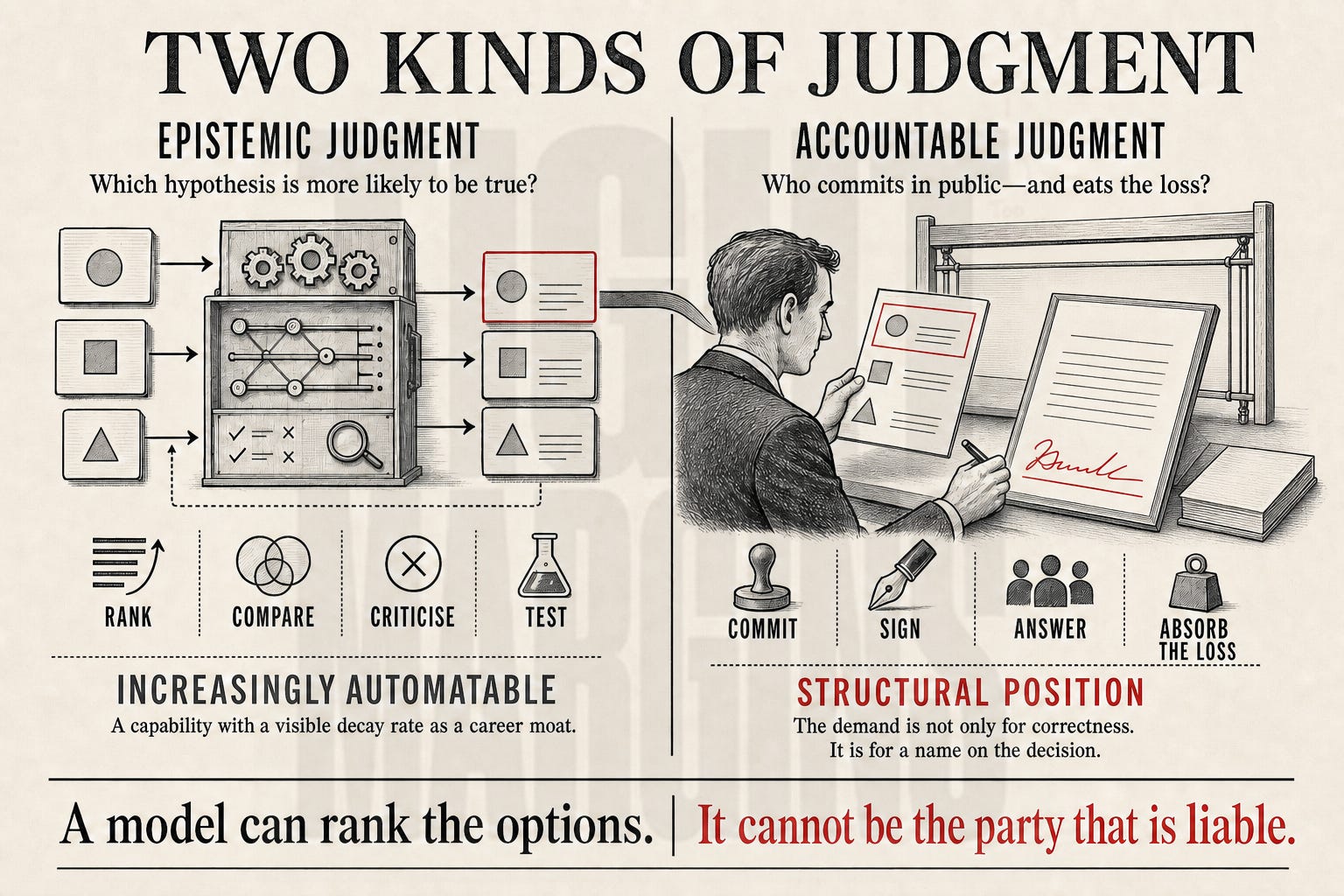
Which is why rung two survives in a world where the machine reasons better than you do. Not a bet on being smarter. A bet on where responsibility can sit.
His challenge does force a concession and I’d rather make it loudly than have it made for me. Some of what follows is structural and some has a decay rate, so each is labelled.
Four questions, each with a number attached
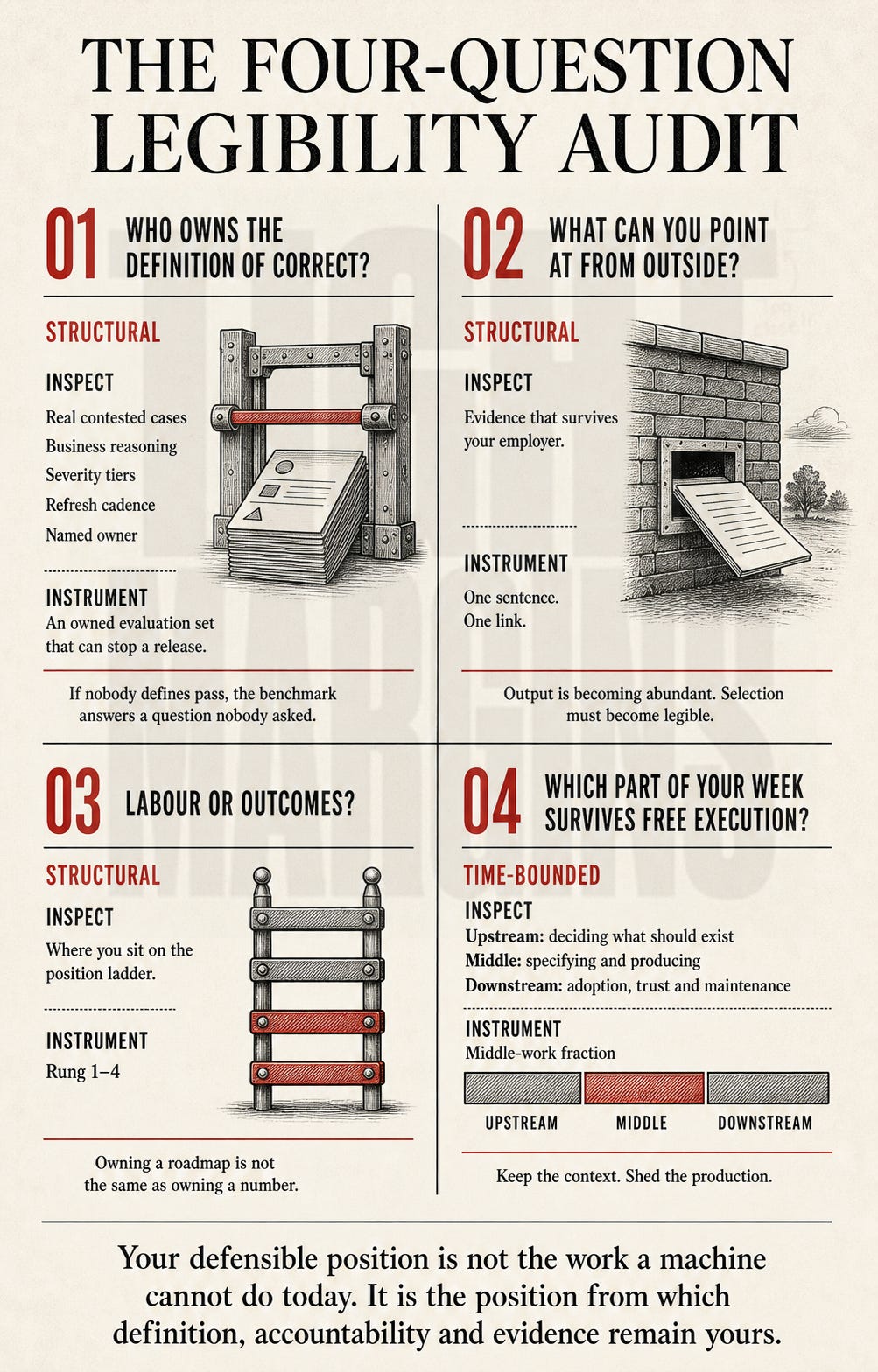
Who owns the definition of correct? STRUCTURAL
Longest section here, because it’s the one with the largest gap between how important it is and how much anybody has written about it.
Start with the practical problem. Acceptance criteria assume determinism. Given this input, when the user does that, then the system produces this. Every QA apparatus a product manager relies on is built on that sentence. Put a model in the path and the sentence breaks, because given this input you get something in the neighbourhood of that, differently on Tuesday.
Most teams respond in one of two ways. They vibe-check in a shared doc, three people trying twenty prompts before launch and calling it good. Or they hand the whole question to engineering as though it were a technical problem, which produces a benchmark number that goes up over time and answers a question nobody asked.
SCENE THREE
A marketplace ships an assistant that explains to sellers why a listing was suppressed. It works. Ninety-four percent of responses are rated helpful in the internal eval.
Then a seller with fourteen thousand SKUs gets told her listing was suppressed for image quality. It was actually suppressed for a category mapping conflict. The answer was fluent, confident, plausible, and about the wrong cause. She spends two days re-shooting photographs.
Engineering’s view is that the model returned a well-formed response and the retrieval step surfaced a real policy document. Nothing failed. Support’s view is that they now have a furious high-GMV seller. Both are correct, and the disagreement can’t be settled by anyone looking at the system, because the question isn’t whether it worked. It’s what we owe a seller when we tell her something about her own business.
That question is not a technical one and engineering cannot answer it. It’s a claim about a user and a business, which is the definition of product work, and right now it’s mostly nobody’s job.
So here’s what owning it actually looks like, concretely, because I’m tired of reading that judgment matters without anyone saying what to build.
A labelled set of real cases, not invented ones. Pulled from actual traffic, and weighted deliberately toward the cases your team argued about internally, because the arguments are where the standard lives. Twenty contested cases beat two hundred obvious ones. Synthetic cases are worse than useless here, since they encode the assumption you were trying to test.
A judgment on each, with the reasoning in business terms. Not “the model hallucinated.” Instead: we told a seller the wrong cause for a suppression, she took two days of action on it, and the cost is a support ticket plus a durable dent in whether she believes us next time. That sentence is the asset. The label is just the index.
A severity tier, which is the part only you can supply. Which failures are cosmetic, which are expensive, which are unrecoverable. A wrong tone is cosmetic. A wrong cause that triggers seller action is expensive. Telling someone their account is fine when it’s about to be suspended is unrecoverable. No model supplies that ordering because it isn’t in the data, it’s in your strategy.
A refresh cadence and a named owner. Distributions shift, and an eval set that isn’t maintained against new disputed cases becomes decorative within two quarters. Which is the EP credit again, arriving as a document rather than a title.
The reason this is a governance position rather than a deliverable: once the set exists and has teeth, passing it becomes the release gate. Whoever defines pass decides what ships. Not advises on what ships. Decides. That’s the accountable-judgment argument turned into an actual job, and it’s currently sitting unclaimed at almost every company I look at, which is a strange thing to be able to say about the most defensible position available in the discipline.
Structural, but only for the person who owns the criteria. Applying them gets automated. Deciding what good means for this business is held by someone with a name.
What can you point at from outside? STRUCTURAL
Answer in one sentence with a link: what exists outside the company currently paying you that is legible evidence you can do the thing?
Most people can’t, and the failure is diagnostic rather than damning. It means your capital is entirely firm-specific, which is fixable and which is the fastest-moving risk on this page. It’s also the thing people discover at the worst possible moment, six years in, when everything they’re proud of turns out to live in a Confluence instance they can no longer log into.
The cleanest evidence I found comes from GitHub’s 2016 decision to let people display private contribution activity on their profiles. A one standard deviation rise in displayed private contributions produced a 5.2% increase in moves to large firms, holding for three years. The finding that matters is the placebo: public contributions and starred repositories showed no effect at all. So the mechanism isn’t portfolio-building. It’s legible evidence of productivity, which is narrower and far more useful than anything on LinkedIn about personal brands.
Which points at making the selection legible rather than the output. Decision records: the bet, what else was on the table, what you killed and why, what happened after. Scene one had no artifact for the three approaches that got killed, and that’s a solvable problem, it’s just one nobody schedules. In a world where a machine also produces the output, the record of what you chose not to do is the only evidence that says anything about you.
Structural because it’s about information asymmetry, not a capability gap that better models close. The writers’ problem in 2015 was never that they weren’t good enough.
Labour or outcomes? STRUCTURAL
Covered in the ladder above, so just the instrument: place yourself on the four rungs before lunch, and notice which one you’ve been avoiding. It’s usually rung two, and usually for the reason given, which is that owning a number means the number gets to be bad where people can see it.
Which part of your week survives free execution? TIME-BOUNDED
Take two weeks of your real calendar and real output, sort every block into three buckets. Upstream is deciding what should exist. Middle is specifying and producing it. Downstream is getting it adopted, trusted, instrumented, kept alive. Compute the fraction in the middle. That fraction is your exposure.
The obvious conclusion is wrong, so one caution. In 2025 METR ran a trial with sixteen experienced open source maintainers on repositories they’d known for about five years and found them 19% slower with AI tools while believing they’d been sped up by 20%. The customer support literature shows the same gradient from the other end: novices gained thirty percent or more, the most experienced picked up a little speed and lost a little quality. Deep context is where the residual advantage currently lives. Keep the context, shed the production.
Time-bounded, and specifically so. METR redesigned that experiment and reported in early 2026 that tooling has probably improved meaningfully since, which is Choudary’s inefficiency arbitrage arriving on schedule. Treat depth as a real position with a decay rate, and spend it buying something structural before it goes.
Where you’re standing changes what you do first
Early-career engineers. Stanford’s payroll work, revised late 2025, found workers aged 22 to 25 in the most AI-exposed occupations down about 16% against older colleagues inside the same firms, with software developers in that band down nearly 20% from a late 2022 peak while older developers kept growing. The detail nobody quotes should decide your response: the adjustment runs through employment, not compensation. Juniors aren’t getting cheaper, they’re getting fewer. Your constraint is the door, not your price once through it, and you have the odd advantage of holding no firm-specific capital worth protecting. Portability, definition of correct, audit, ownership.
Senior engineers. Your advantage is exactly what the evidence says the tools don’t touch, and exactly the thing with the shortest shelf life. Substitution isn’t the risk. Spending a decaying asset on production work is. Audit first so you can see it, then convert into the safety net, where context becomes a position rather than a skill. Audit, definition of correct, ownership, portability.
IC product managers. More of your job sits in the compressible middle than either of the other two roles: specification, coordination, status. Then take the definition of correct, which is unclaimed almost everywhere I look and is the strongest position available to you. Audit, definition of correct, ownership, portability.
Directors and above in product. One proprietary dataset, directional at best, suggests the PM contraction has been top-heavy rather than bottom-heavy, with VP and director roles falling furthest. Opposite shape to engineering. If it’s even roughly right, the layer you occupy is being questioned as a layer, and craft won’t defend it. Ownership will: a number rather than an organisation, because organisations get restructured and numbers get protected. Ownership, audit, portability, definition of correct.
As VP Product at Zepto, I was responsible for delivering the Ad Revenue. I was owning the number. At Walmart, in my multiple stints, I was responsible to delivering business attributable numbers.
Conclusion
Robert Grant opens the Madonna case in Contemporary Strategy Analysis by killing the obvious explanation. “Certainly not outstanding natural talent. As a vocalist, musician, dancer, songwriter, or actress, Madonna’s talents seem modest.” His teaching note grades her a B or A minus on every craft skill and says she scores highest on marketing, self-promotion and work ethic. Everyone takes “keep reinventing yourself” out of that case and it’s the weaker half. The stronger half is that she’d worked out precisely which of her capabilities was scarce, and outsourced the rest without sentiment.
Choudary’s right that the firms which die are the ones still optimising a game built around a scarcity that already evaporated. The version available to a person is narrower and easier to make, because it looks like diligence: keep producing the artifact that used to be the evidence, and keep expecting it to be read as evidence.
The writers were scarce and couldn’t prove it, and it cost them a decade and 148 days on a picket line to win a partial fix that still arrives under a confidentiality agreement. Nobody’s negotiating ours. Density in this profession is 3.7% and there’s no vehicle to build on.
So the individual version of the learning architecture is smaller and duller than the organisational one. A firm can design a system that searches broadly, learns cheaply and commits selectively. A person can only occupy a position inside somebody else’s, and make the occupancy legible from outside it. Less inspiring than it should be, and it’s what the evidence supports.
Winslet took a producer credit on a seven-episode show and learned to produce by producing. Four levers, named, in writing. That’s rung one.
You don’t have to guess what happens next. Something with this shape already happened, to people who wrote down what it cost them.
SOURCES AND NOTES
Sangeet Paul Choudary, “Scarcity and Strategy: Misreading AI the Way Hollywood Misread Streaming,” Platforms, August 2026. The bottleneck migration framing, the prime-time-slot reading of streaming, the exploration-cost argument and the learning architecture conclusion are his. The legibility condition is my amendment and he shouldn’t be blamed for it.
Scenes one, two and three are constructed composites, not reported incidents.
Winslet quote: Collider, 19 April 2021. Mare of Easttown, HBO, 18 April to 30 May 2021, seven episodes, Winslet credited as executive producer from the 2019 announcement. True Detective season one, HBO, January 2014. Both premium cable rather than streaming originals, which matters if you’re arguing about causes.
Writer employment and earnings: WGA West annual financial reports. The 2018 to 2023 series (6,426 / 6,821 / 6,679 / 6,695 / 6,835 / 5,501 writers reporting, against $1,670.0m / $1,828.2m / $1,769.9m / $1,802.2m / $1,894.8m / $1,291.4m) is published by the Guild; the real-terms figures are mine, deflated by CPI-U annual averages. 2024 changes via the Guild’s 2025 report as reported by Forbes, 30 June 2025. I’ve kept the load-bearing comparison inside 2018 to 2022 deliberately: the Guild struck from 2 May to 27 September 2023 and its own report attributes that year’s fall to the contraction and the strike jointly without apportioning them, so the 2023 figures cannot carry an argument on their own. The two published 2024 percentages do not reconcile exactly against the headcounts, most likely late-reporting revisions, so I’ve quoted the percentages rather than deriving a 2024 count. Minimum-scale shares via the Guild’s 2023 negotiating bulletins.
Residuals and buyouts: WGA West annual financial reports, FY2022 and FY2024; Sarandos via Variety, 17 October 2024; residual history via Fortune, 19 July 2023. Data opacity: The Hollywood Reporter, 15 November 2021; Soderbergh via Rolling Stone, August 2023. Settlement terms from the WGA’s summary of the 2023 MBA and SAG-AFTRA’s summary agreement; bonus take-up via The Hollywood Reporter, 30 January 2025.
Peak TV counts: FX Networks Research via Variety, January 2023 and February 2024. Luminate’s parallel count runs two to three times higher on a broader definition, so don’t mix the series.
Ownership ladder: Robbie via Variety, 2023, anonymously sourced and therefore reported rather than disclosed. Hello Sunshine via CNBC, Variety and The Hollywood Reporter, 2 August 2021, with stake figures from Forbes the same day, which labels them estimates. Aviation via Diageo’s own release, 17 August 2020. Mint via T-Mobile, March 2023 and May 2024; $1.35bn was a maximum and the price at close was never disclosed. Producer credit inflation via Stephen Follows, April 2026; deal contraction via the BOE Producer Deal Tracker, June 2026, self-published with a stated methodology.
AI and software: Cui, Demirer, Jaffe, Musolff, Peng and Salz, Management Science, online 27 February 2026. METR, “Measuring the Impact of Early-2025 AI on Experienced Open-Source Developer Productivity,” July 2025, with METR’s February 2026 note that it redesigned the experiment and believes tooling has improved meaningfully since. Brynjolfsson, Li and Raymond, “Generative AI at Work,” QJE 140(2), 2025. Brynjolfsson, Chandar and Chen, “Canaries in the Coal Mine?”, Stanford Digital Economy Lab, revised 13 November 2025; the authors noted in February 2026 that under stricter controls the decline only becomes notable from 2024, and the Yale Budget Lab finds no economy-wide disruption signature in aggregate occupational mix, which is less of a contradiction than it looks. PM contraction figures from Live Data Technologies via Mind the Product, June 2026: proprietary, scraped, third-hand, directional only. GitHub study: Gupta, Nishesh and Simintzi, “Big Data and Bigger Firms,” February 2025. Union density: BLS union members release, reference year 2025.
Robert Grant’s textbook Contemporary Strategy Analysis replaced Madonna as the chapter one case by Queen Elizabeth II and Lady Gaga in later editions.