
Synthetic Competence
The cost of looking competent has collapsed. Organizations have not updated their tests.

This series has argued that dangerous leadership is produced by the interaction of competence, self-correction capacity, and power—and by promotion systems that observe those variables badly. Previous essays mapped the resulting configurations and their consequences for authority, positioning, and compensation.
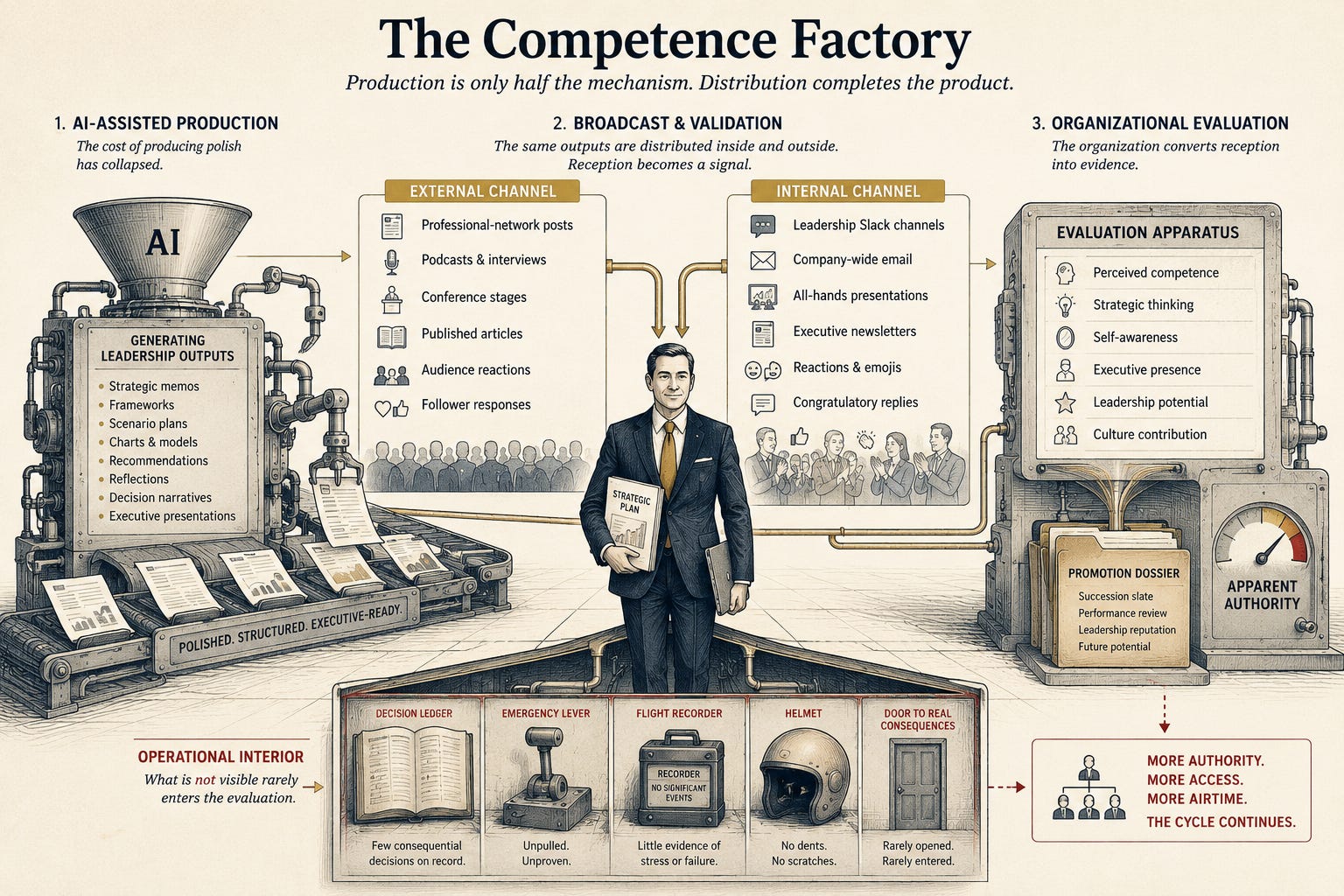
The mechanism is not new. This essay examines what happens when two structural forces lower the cost of producing the signals on which it depends.
AI makes competence cheaper to counterfeit. Social media makes power cheaper to hallucinate. Together, they make self-awareness easier to perform without enacting. The production mechanism becomes more efficient just as the signals organizations rely on become harder to verify.
What AI does to each axis
AI is not uniformly corrosive to the three-axis framework. It improves real things and corrupts real things simultaneously, and the two effects are not symmetrical in their organizational consequences.
Competence
What AI genuinely improves: Analysis, synthesis, scenario planning, and the quality of structured thinking at speed.
What AI makes dangerous: Simulating judgment without possessing it; producing work that resembles genuine analytical capability at the surface level.
Self-correction
What AI genuinely improves: Critique, premortems, red-teaming, and simulation of how decisions land on others.
What AI makes dangerous: It can become an ego prosthetic—confirming the model you already have rather than challenging it.
Power
What AI genuinely improves: Individual reach and leverage. One person can now do what previously required a team.
What AI makes dangerous: Fewer people observe the work, so fewer corrective signals enter the system as individual leverage expands.
The most consequential effect is on competence, and it is specific. Before AI, a high-quality analysis, coherent strategic argument, or well-structured decision memo required either genuine analytical capability or significant time. AI lowers both requirements. A person with limited analytical capability but good prompting instincts can now produce work that resembles genuine judgment. The difference becomes visible only when the analysis meets reality: time pressure, incomplete information, novel conditions, and consequences that cannot be edited away.
The diagnostic question shifts from “can they produce a good answer?” to “can they judge whether the answer is good?” These are not the same question, and the second one is significantly harder to observe under normal organizational conditions.
What broadcast channels do to each axis
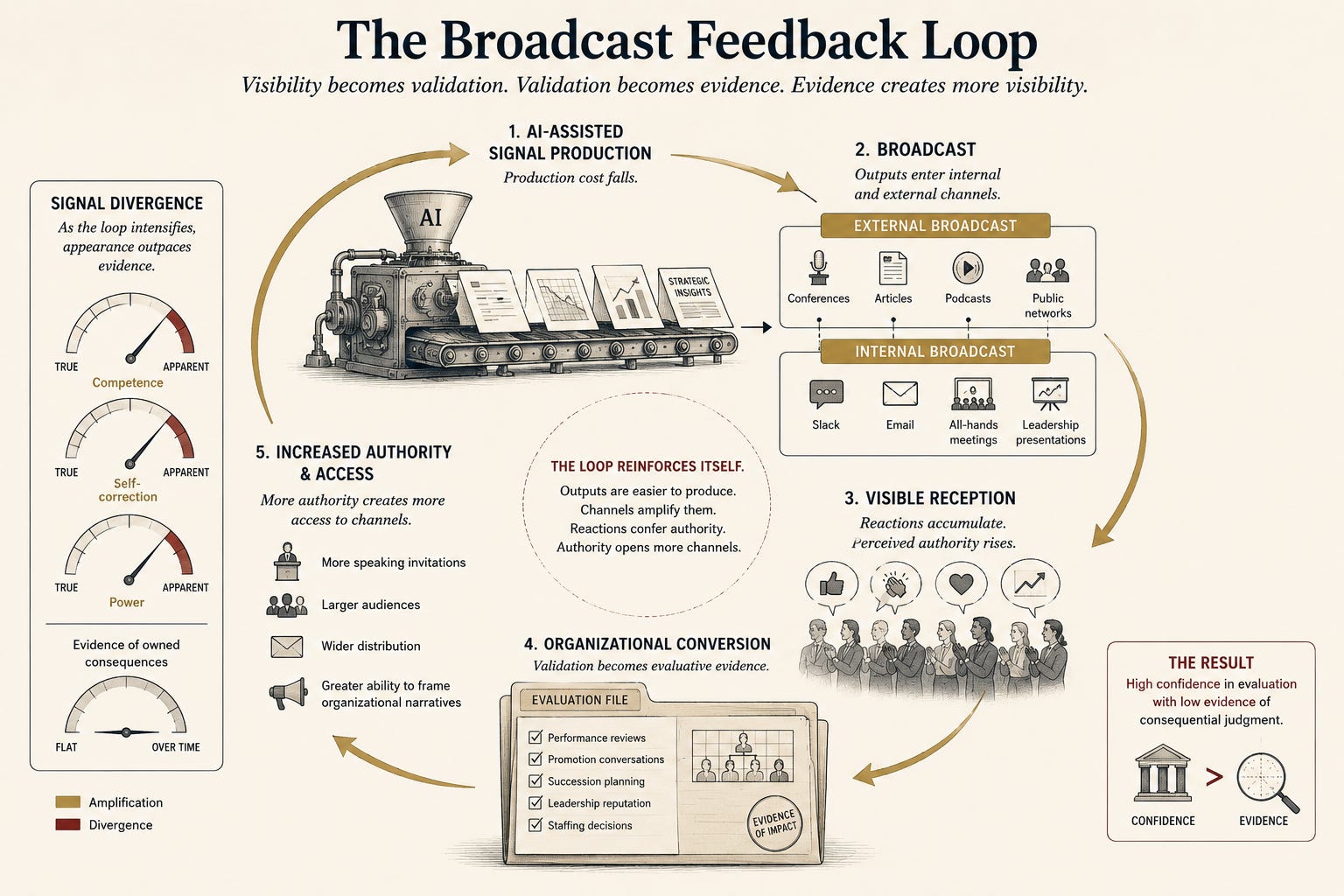
Social media operates through a different mechanism. AI changes what outputs people can produce; social media changes which outputs receive status. It converts visible signals into influence while separating them from operational consequences. AI makes the counterfeit easier to manufacture, and social media creates the market for it.
The term social media, as this essay uses it, is not confined to LinkedIn posts and Instagram reels. It includes any channel through which signals about competence, self-awareness, or authority can be broadcast, curated, and consumed without being tested against operational consequences. Internal Slack announcements, company-wide emails, all-hands Q&A sessions, leadership newsletters, and team presentations all function through the same mechanism. The distribution channel differs. The dynamic is identical. A carefully drafted Slack message to a leadership channel and a LinkedIn thought-leadership post are both performing the same function within this framework. The internal version is arguably the more consequential of the two, because it feeds directly into the evaluation system the previous essays described rather than merely shaping peripheral impressions. A person who never posts publicly can still benefit fully from this dynamic if they manage their internal signal architecture well.
Competence
What social media can provide: Exposure to ideas, weak signals, and public critique that an organizational environment may filter out.
What it distorts: It rewards confidence, compression, and moral clarity while punishing uncertainty, trade-offs, and the answer that begins with “it depends.”
Self-correction
What social media can provide: Feedback loops at scale, including critical feedback that internal environments suppress.
What it distorts: It turns reflection into performance. Public vulnerability is curated, edited, and audience-tested before publication.
Power
What social media can provide: Genuine reach and influence for people without formal institutional authority.
What it distorts: Audience size is mistaken for decision authority—apparent influence without operational accountability.
The social media distortion of self-awareness is the most insidious because it wears the appearance of its opposite. The leader who posts publicly about their leadership mistakes, their growth edges, their reflections on failure is performing exactly the signal that the framework identifies as valuable: self-correction capacity. But the post is retrospective, curated, consequence-free at the moment of presentation, and optimized for audience engagement rather than accuracy. Performed self-awareness and actual self-correction capacity are not the same variable. Social media has made the gap between them profitable.
The new archetype
AI lowers the cost of sounding competent. Social media raises the reward for appearing to lead. Together, they have produced a new leadership archetype that the existing diagnostic framework was not designed to catch.
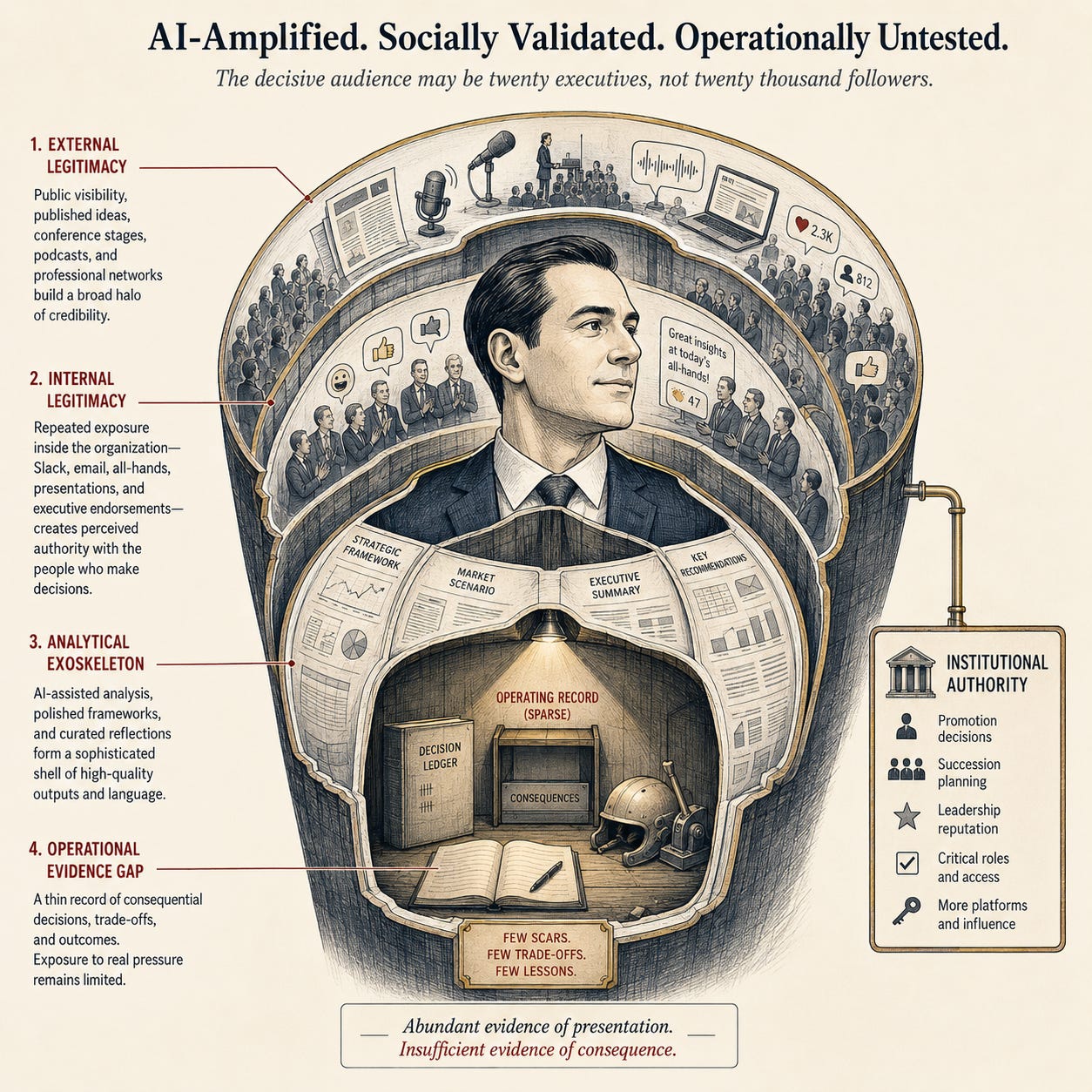
THE NEW PATHOLOGICAL CONFIGURATION
AI-Amplified. Socially Validated. Operationally Untested.
AI-AMPLIFIED
Their outputs look like the work of someone with genuine analytical judgment. Their memos are well-structured. Their frameworks are coherent. Their analyses are thorough. None of this requires them to possess the underlying capability that would allow them to make good decisions in real time under conditions the AI cannot anticipate.
SOCIALLY VALIDATED
Their audience, internal and external, reads as institutional authority. Their public and internal self-reflection reads as self-awareness. Their confidence in presentations, all-hands sessions, and leadership emails reads as command of the subject. All three signals are real. None of them are observing the variable they appear to measure. The internal variant is often the more effective one: Slack reactions, leadership email replies, and all-hands applause feed the same validation loop as follower counts, but through channels that are also the primary inputs to the evaluation system.
OPERATIONALLY UNTESTED
They have never been in a position where a decision they made under time pressure with incomplete information produced a consequence they could not narrativize away, route to someone else, or fix before it became visible. This is not rare. It is the precondition for much of the apparent leadership that social media validates.
This archetype is not the Organizational Hazard from the fourth essay. That configuration accumulated power through a long institutional process. The new archetype can enter already carrying apparent competence and apparent influence manufactured outside the institution. Existing feedback architecture is not designed to verify either.
The production mechanism therefore becomes more efficient. Feedback systems were already poor at surfacing self-correction capacity; they are now confronting signals specifically optimized to resemble the variables they were built to measure.
The diagnostic shift
The test that survives this environment is the one that AI cannot take and social media cannot curate. It is not a test of output quality. It is a test of owned consequences.
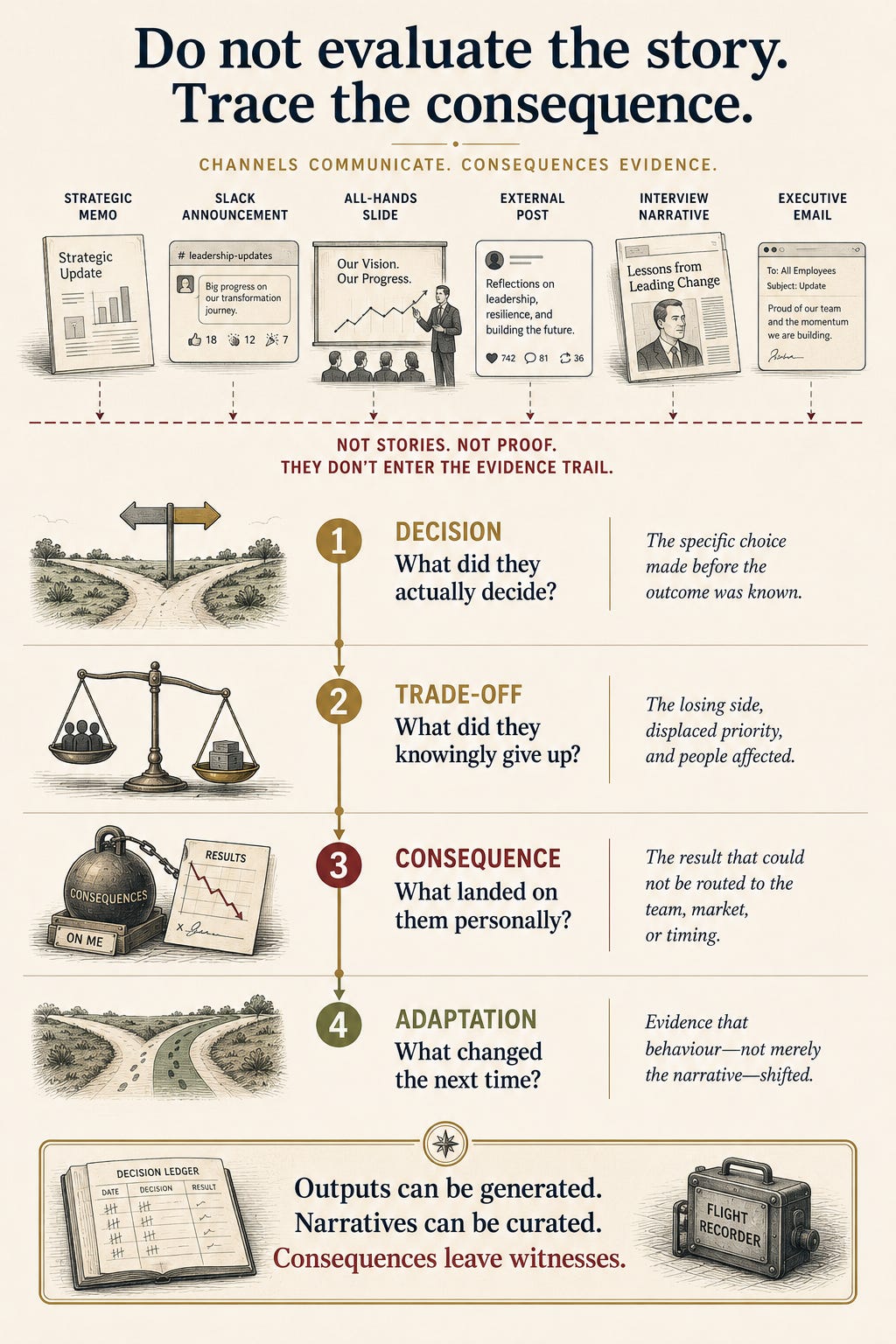
These questions are hard to answer through a social media profile. They are hard to answer through AI-assisted interview preparation. They require access to people who observed the person under actual conditions of failure, with real stakes and real consequences, which is exactly what the twenty-to-thirty-stakeholder promotion-decision 360° the second essay recommended was designed to surface.
The diagnostic shift is from outputs to owned consequences. It is not a shift that makes evaluation easier. It is a shift that makes it more accurate, and more resistant to the counterfeiting that AI and social media have made structurally available.
What this means for the framework
AI and social media do not change the three-axis model. Competence, self-correction capacity, and power still determine whether leadership is governable or catastrophic. What changes is the observability of all three: the apparent version is easier to manufacture, while the true version is harder to verify.
This has two implications.
For organizations, the feedback architecture argument is more urgent. Evaluating people through their best-lit moments was already producing dangerous configurations. Promotion systems that continue to privilege visible outputs over owned consequences will now do so faster and with noisier evidence.
For individuals, the self-awareness tax becomes both more costly and more valuable. Low-self-awareness, high-confidence configurations benefit disproportionately from cheap analytical polish and public validation. Yet genuine self-correction becomes more valuable precisely because its imitation is now abundant.
AI can manufacture polished output. Broadcast channels, from LinkedIn to the company all-hands, can manufacture apparent authority. Neither can manufacture a history of sound decisions, owned trade-offs, absorbed consequences, and changed behaviour. That is where the signal now lives.
The framework is not a solution. It is a tool for seeing the mechanism accurately. Accurate diagnosis still precedes any intervention worth making.
This is the seventh and final essay in a series on the mechanics of bad leadership and what they mean for the people navigating organizations that produce it.