
When Moving Fast Is Actually Right
The infrastructure that makes "moving fast" actually work


Let me be direct about something before we go further.
This series has argued that “bias for action” is often bad management disguised as courage. That speed has costs most leaders aren’t measuring. That the pressure to move faster is frequently misdiagnosed, non-portable, and applied without regard for the structural conditions that make speed safe.
All of that is true. But if you have read this as an argument against speed, you have read it wrong.
Speed is sometimes the correct optimization.
Not as a slogan. Not as a cultural performance. As the structurally correct strategy given a specific cost structure that a specific team has built.
The question this piece answers is: when is bias for action genuinely right, and how do you tell the difference between an organization that has earned the right to move fast and one that is simply not counting the cost?
Two Ways to Be Fast
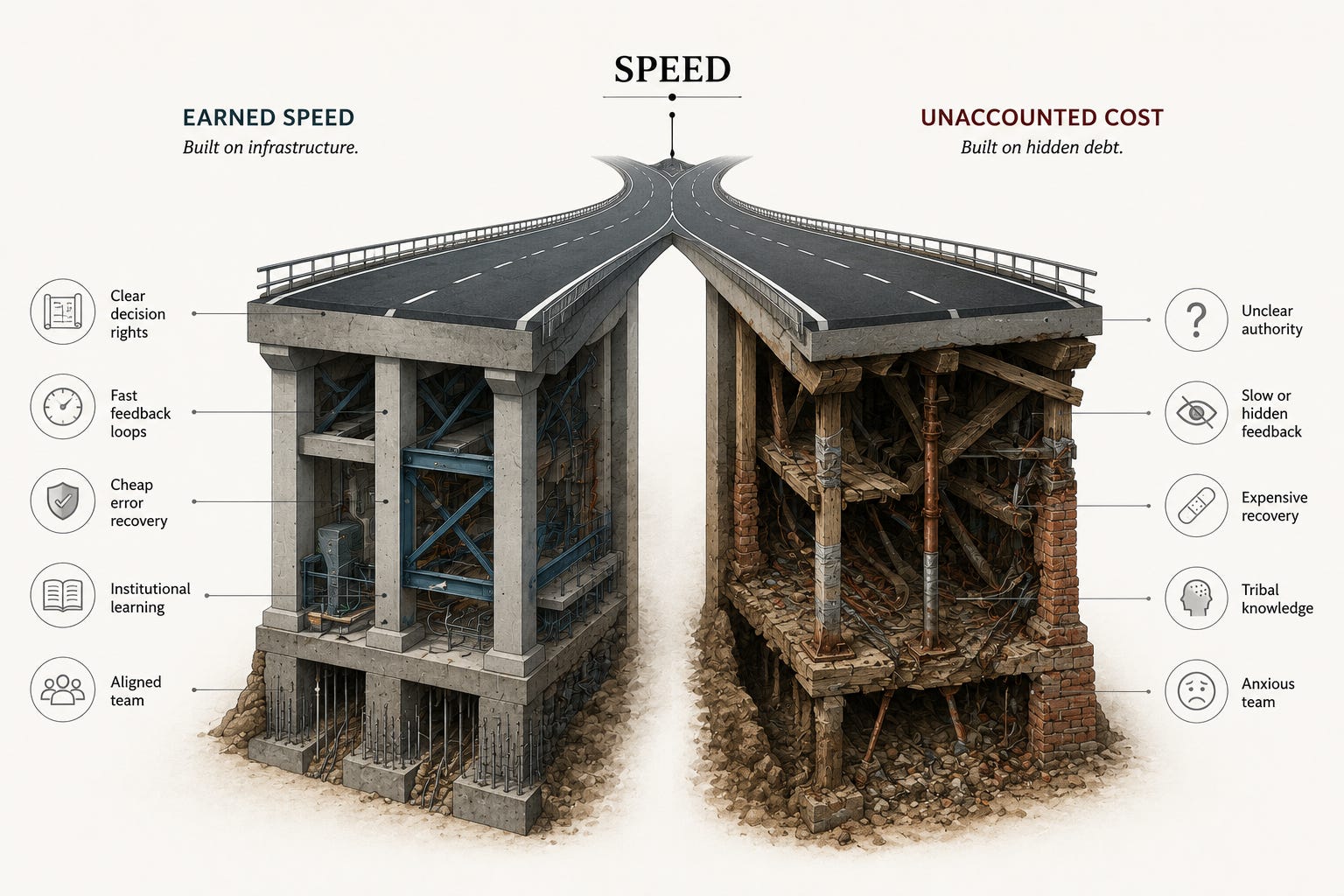
There are two fundamentally different reasons an organization moves fast.
The first is earned speed. The organization has invested in infrastructure that makes velocity safe. Decision rights are clear. Feedback loops are tight. Information flows quickly. Mistakes are caught early and cheaply. The team moves fast because the system is designed to absorb the risks of speed. Velocity is the dividend on a structural investment.
The second is unaccounted cost. The organization moves fast, but nobody is measuring what it costs. Decisions are made quickly, and the rework happens somewhere else. The errors land on a different team. The trust erosion shows up next quarter. The technical debt compounds silently. Speed looks cheap because the invoice goes to a different department, or to the future.
From the outside, these look identical. The team ships fast. The culture celebrates velocity. The leadership deck says bias for action.
From the inside, they feel different. In earned speed, people are confident. In unaccounted cost, people are anxious. They know the corners being cut. They just can’t name the cost in a format leadership accepts.
The entire question of whether bias for action is right for your team reduces to which of these you are in.
When Speed Gets Cheaper the Faster You Go
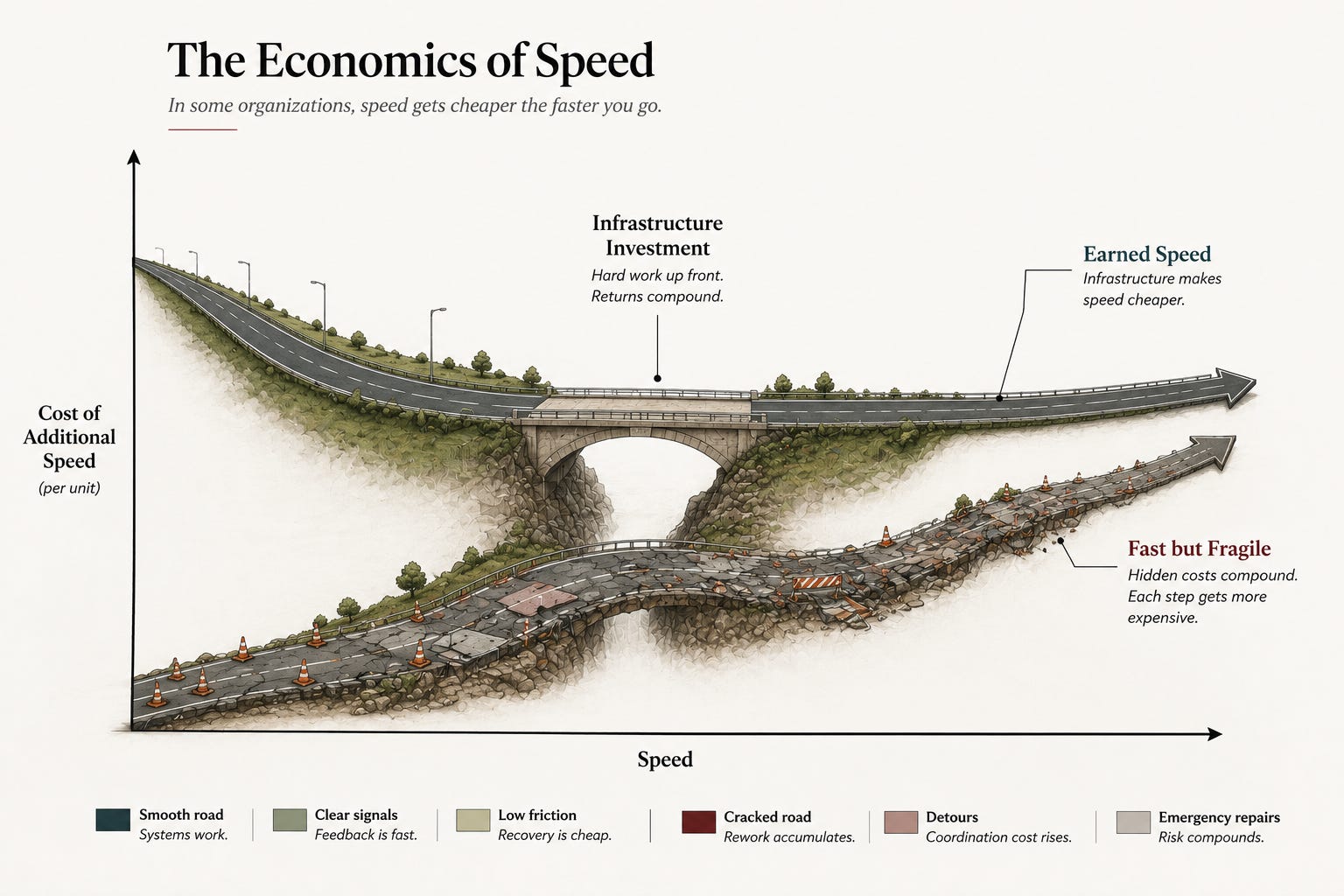
Here is something counterintuitive about some organizations: the faster they go, the cheaper each additional unit of speed becomes.
Think about why.
If you have built pre-authorized decision frameworks, the first decision that gets pre-authorized costs the effort of building the framework. The hundredth costs nothing. The framework absorbs it.
If you have built clear ownership, every decision that doesn’t require escalation is free velocity. The investment was in the clarity. The speed is the dividend.
If you have built fast feedback loops — automated monitoring, real-time analytics, rapid customer signal — then moving fast and being wrong is cheap because you detect the error almost immediately. The cost of a bad decision is bounded by how quickly you can see the result.
In these organizations, speed has increasing returns. The more you have invested in the infrastructure, the cheaper each increment of speed becomes. And the optimal strategy in an increasing-returns environment is to lean into it. Go fast. Not because you are being reckless, but because the system is built to make fast safe.
This is the valid insight buried inside every “bias for action” keynote. Some organizations genuinely should optimize for speed — not as ideology but as the structurally correct strategy given their cost curve.
The problem is not the strategy. It is that organizations claim increasing returns on speed when they haven’t made the investments that produce them. The Fast-but-Fragile1 Team that declares “bias for action” without building feedback loops or institutional memory isn’t optimizing for speed. It’s borrowing from the future without a repayment plan.
What Earned Speed Looks Like
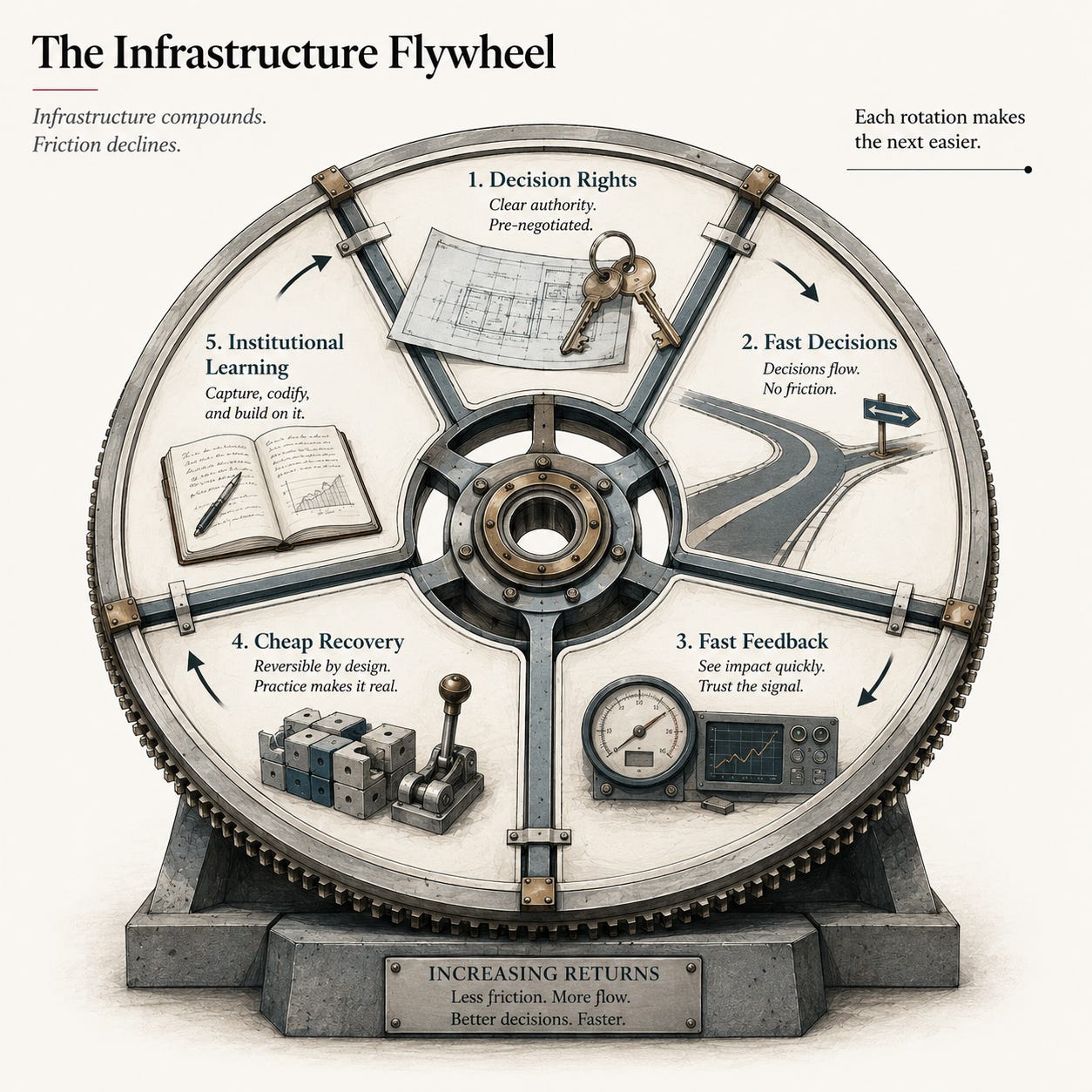
You can spot earned speed by its infrastructure, not its velocity. The velocity is the output. The infrastructure is the input.
Decision rights are explicit and documented. People know who can approve what, up to what threshold, without escalation. This isn’t anarchy. It is pre-negotiated authority. The difficult conversations happened once, upfront, rather than happening implicitly on every decision.
Feedback loops are fast and trusted. The team can see the impact of a decision within hours or days, not weeks. Automated monitoring, real-time dashboards, direct customer signal. When something goes wrong, the system tells you. When something goes right, the signal is equally clear.
Error recovery is cheap and practiced. The team has rolled back before. They know how. Feature flags, canary deployments, modular architecture. Reversibility isn’t theoretical. It is operational. The team has exercised it and knows the actual cost.
Institutional learning is embedded, not oral. Past decisions are documented with their rationale and outcomes. New decisions reference old ones. The team doesn’t repeat mistakes because the mistakes are recorded, not because someone happens to remember.
The team can articulate what they are optimizing for. Ask any member what the current priority is and you get the same answer. Strategic clarity isn’t perfect, but it is sufficient. People don’t need to pause and check whether this decision aligns with the direction. They know.
This is the infrastructure of the Compounding Organization. The reason that archetype can achieve both cheap speed and cheap quality simultaneously is that it has built the scaffolding that makes each cheaper. Speed has increasing returns because the system was designed for it.
If your team has most of these, bias for action is likely correct. The scaffolding earns the speed.
What Unaccounted Cost Looks Like
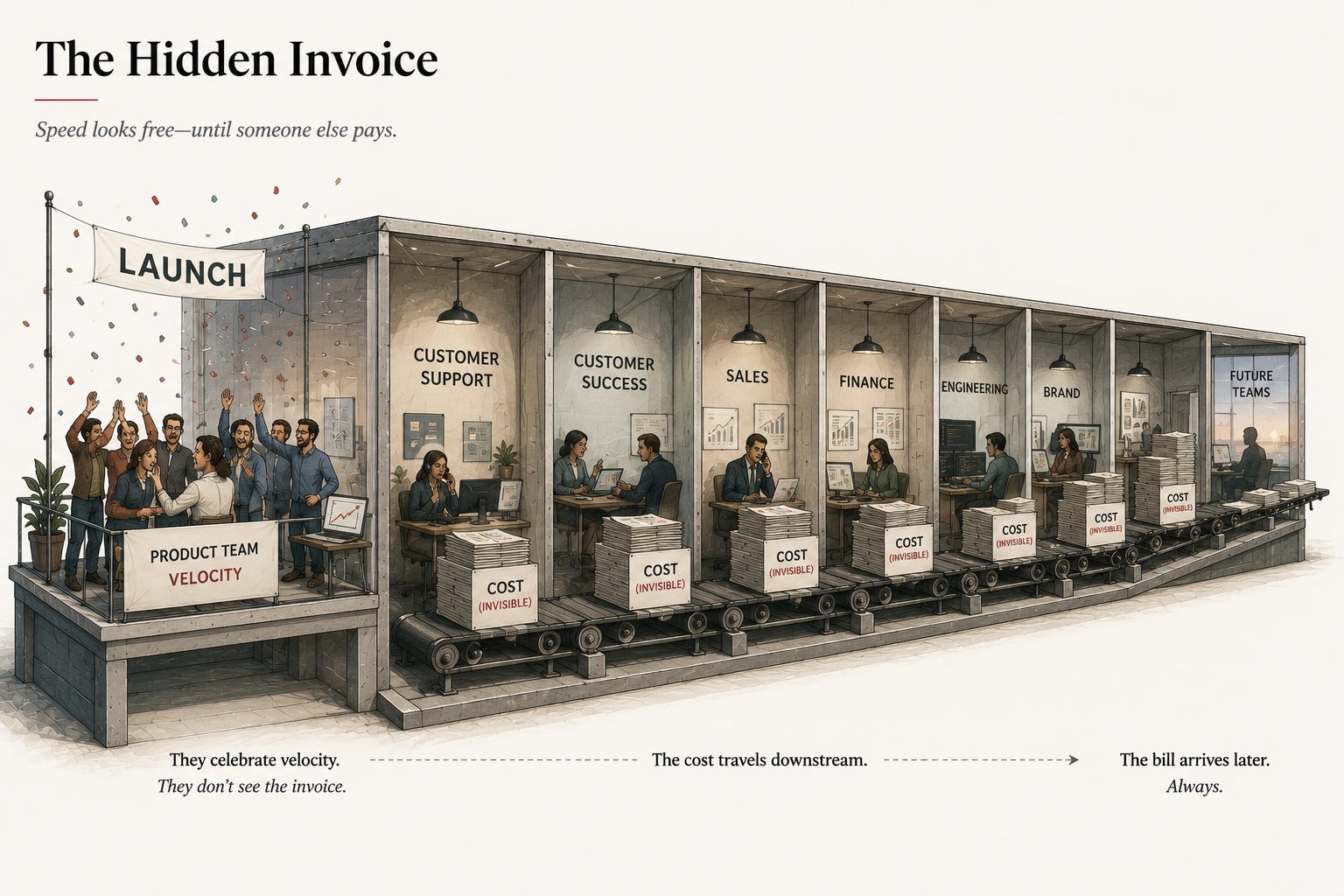
Unaccounted cost is harder to spot because it often looks like earned speed from a distance. The team ships fast. The metrics go up. Leadership is happy.
But the warning signs are there if you know where to look.
Rework is chronic but unreported. The team ships, then quietly fixes. Then fixes the fix. If your team’s velocity looks great on the sprint board but the same features keep showing up two or three cycles later, you are not fast. You are cycling.
Quality problems land on other teams. Your team shipped fast and the support team handled the fallout. Your team made the pricing decision and the account management team managed the churn. The cost exists. It just doesn’t show up on your dashboard.
Post-mortems keep finding the same root causes. “We didn’t have enough context.” “We didn’t check with that team.” “We didn’t realize this was connected to that.” If your retrospectives sound the same every quarter, you are not learning from speed. You are paying for it repeatedly.
People are anxious, not confident. Earned speed feels like flow. Unaccounted cost feels like running on ice. The team senses the brittleness. But the culture rewards shipping, so they ship and worry privately.
Nobody can tell you the cost of the last bad decision. Ask your team: what did our last major mistake actually cost us? If the answer is a shrug or a guess, you are not tracking the cost of speed. You are not measuring it.
This is how the Fast-but-Fragile Team transitions into the Heroics Factory. Not through a single catastrophic decision, but through accumulated debt that nobody is counting. The speed is real. The invoice is also real. It just arrives later, addressed to someone else.
The Honest Test
Five questions. Answer based on what actually happens, not what the culture deck says.
1. When your team makes a bad decision, how long until you know?
Hours: earned speed. Your feedback loops are working.
Weeks or months: unaccounted cost. Errors compound before detection.
2. When you detect an error, how long until it’s fixed?
Same day: earned speed. Recovery is practiced and cheap.
Multiple cycles: unaccounted cost. Reversibility is theoretical, not operational.
3. Who absorbs the impact of a wrong decision?
The team that made it: earned speed. Accountability and cost are co-located.
A downstream team: unaccounted cost. You have externalized the invoice.
4. Can a new team member explain your decision-making process?
Yes, because it is documented: earned speed.
No, it is tribal knowledge: unaccounted cost. The system depends on memory, not design.
5. Does your team’s velocity measure include rework?
Yes: earned speed. You are measuring net velocity.
No: unaccounted cost. You are measuring gross output and calling it progress.
Four or five earned speed answers: your team has built the infrastructure for safe velocity. Bias for action is the correct strategy. Lean into it.
Three or more unaccounted cost answers: your speed is real but your cost accounting isn’t. You are borrowing from the future and calling it velocity.
Speed Is Built, Not Declared
The deepest mistake in the “bias for action” conversation is treating speed as a cultural value rather than an infrastructure outcome. You cannot declare your way to safe velocity.
Putting “bias for action” in your values doc and expecting the organization to move faster is like putting “we value fitness” on a gym poster and expecting everyone to get stronger. The poster doesn’t build the muscle. The infrastructure does.
What does it mean to invest in speed as infrastructure?
Pre-authorize. Identify the categories of decisions that don’t need escalation. Document them. Make the authority explicit. Every decision you pre-authorize is a decision that no longer costs coordination overhead.
Shorten feedback loops. If your team can’t see the impact of a decision within 48 hours, invest in the monitoring that changes that. Real-time signal isn’t a luxury. It is the safety net that makes speed sustainable.
Practice rollback. Don’t just design for reversibility. Exercise it. Know what it actually costs under pressure. Theoretical reversibility is worth nothing if nobody has triggered it.
Measure net velocity, not gross output. Count the rework. Count the downstream impact. Count the recovery cost. If your team ships ten things and three need rework, your velocity isn’t ten. It is seven, with a quality tax.
Document decisions, not just outcomes. Record the rationale, the alternatives considered, the risks accepted. Future you needs this. Without it, every decision starts from scratch and institutional learning resets to zero every time someone leaves.
These investments are unglamorous. Nobody posts about pre-authorization frameworks or rollback drills. But they are what separates organizations that are fast from organizations that merely look fast.
The Compounding Organization is fast because it made these investments. The Fast-but-Fragile Team is fast because it didn’t make them yet. The difference isn’t culture. It isn’t mindset. It is infrastructure.
Try This Before Your Next Retrospective

Pick two decision classes your team makes regularly.
For the first, choose one where you believe you have earned the right to move fast. Where you have clear ownership, fast feedback, cheap recovery, and documented rationale. Name it. Write down why you believe speed is safe here. Be specific: what infrastructure absorbs the risk?
For the second, choose one where your team moves fast but you suspect the cost is unaccounted. Where decisions ship quickly but rework follows quietly. Where errors land on someone else’s dashboard. Where you can’t name the cost of the last mistake. Name it. Write down what you think the actual cost is.
Now adjust. For the first: confirm the infrastructure is still in place and lean into the speed. For the second: either invest in the infrastructure that would make speed safe, or acknowledge that this decision class needs more deliberation than it is getting.
Share both with your team. Make the distinction explicit. “For decisions like X, we move fast because we have earned it. For decisions like Y, we slow down because we haven’t.”
That sentence, written down and shared, is worth more than any bias for action mandate. Because it tells your team when to be fast and when to be careful, instead of pretending the answer is always the same.
Speed is not a virtue. It is a capability. And like all capabilities, it is only as valuable as the infrastructure that makes it safe to use.
Next in The Speed Trap series: “Your Market’s Forgiveness Profile” — why the same mistake costs you one transaction in one market and six months of pipeline in another, and why advice that works in consumer tech doesn’t port to enterprise, financial services, or B2B marketplaces.
