
Safe Operating Speed
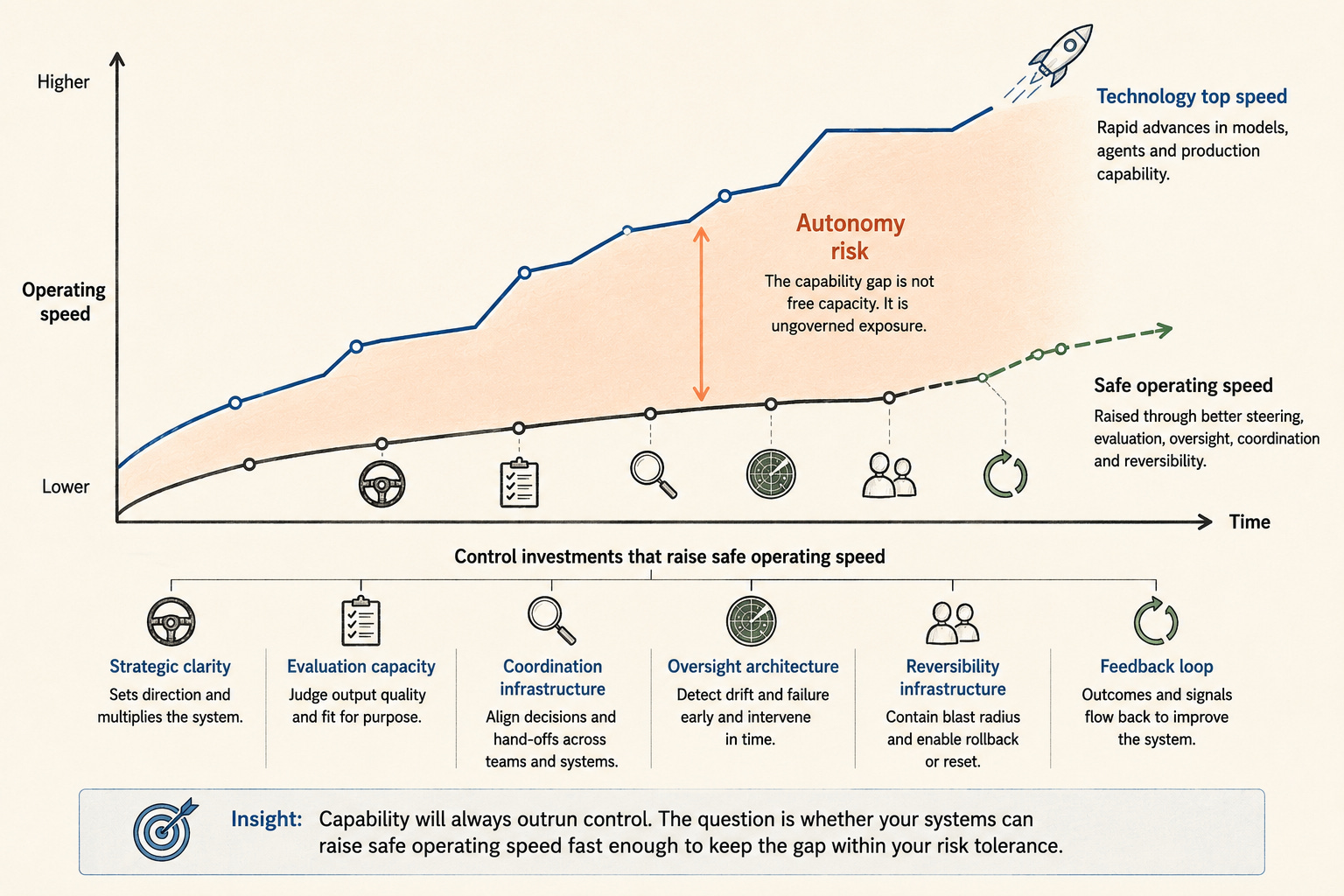
Your technology has a top speed. Your organization has a different one. Almost everything that goes wrong in the agentic era lives in the gap between them.

Last piece in the series, which makes it the one where I owe you something more useful than a diagnosis. Four parts of naming a problem is about three parts more than most readers have patience for.

Where the diagnosis landed, briefly:
Production speed and decision speed are not the same thing, and treating them as one is the mistake most of the AI era is built on.
Your organization has a shape. It sets what speed costs you and what quality costs you, and no amount of tooling changes it.
Speed is either earned or unaccounted. The difference is not how fast you are moving. It is whether you have built anything that would tell you if you were wrong.
And your market has a forgiveness profile, which sets the price of being wrong in public.
So: now what.
Two Speed Limits
The first speed is the one your technology can hit. Agents, models, the production pipeline behind them. It is fast, it gets faster roughly every quarter, and it is the number in the vendor demo and in your competitor’s press release.
The second is the speed at which your organization can absorb new capability while still noticing when something has gone sideways, correcting it, and keeping enough trust intact that people will tell you the truth the next time. That is your safe operating speed.
It sits below the first one, always. Not because your organization is slow. Steering costs something, and the cost is real even in a fast company.
The gap between the two is where your risk lives. I have been calling it autonomy risk, mostly for want of a better term. The wider it gets, the more of your operation is running on an assumption nobody has said out loud: that nothing will go badly wrong in a place you cannot see.
Some of that gap is fine, and some of it is deliberate. If reviewing every automated decision costs more than the errors those decisions produce, you should let them run. That is a real tradeoff and plenty of teams make it correctly. The trouble starts when the gap widens on its own, a quarter at a time, and nobody ever sat in a room and chose to accept it.
The Debt You Are Already Carrying
When the gap widens quietly, you accumulate something I would call autonomy debt. Autonomy risk is the exposure created by the gap; autonomy debt is the accumulated deficit in the controls required to manage it. It behaves like technical debt: cheap to ignore, compounding while ignored, unpleasant to service on the day it comes due.
Four ways it builds up.
Agents ship without governance. Survey figures here vary enough that I would treat any single number as directional, but the direction is consistent across everything I have read this year: a large majority of enterprises now report agents in production, and something close to the same majority report no formal governance over them. Each one is a line of debt.
Departments build in silos. An agent in HR. One in finance. Two in support, one of which nobody remembers commissioning. With no registry, you cannot answer the basic questions: how many are running, what they are deciding, whether anyone still needs them. These are ghost agents, and they are not a thought experiment. A team I know found a scheduled process that had been adjusting prices for five months after the person who built it changed roles.
Exception handling is undefined. Your agent can act inside some set of parameters. Fine. What happens at the edge of them? What condition triggers a handoff? If the honest answer is that nobody has worked it out, then every edge case is a debt event waiting for its moment.
Nobody prices the errors. The errors are happening either way. The invoice just arrives somewhere you are not looking: support volume, seller complaints, a margin line that has drifted two points and got written off as mix. If you cannot say what your agents’ last significant error cost, you are accruing.
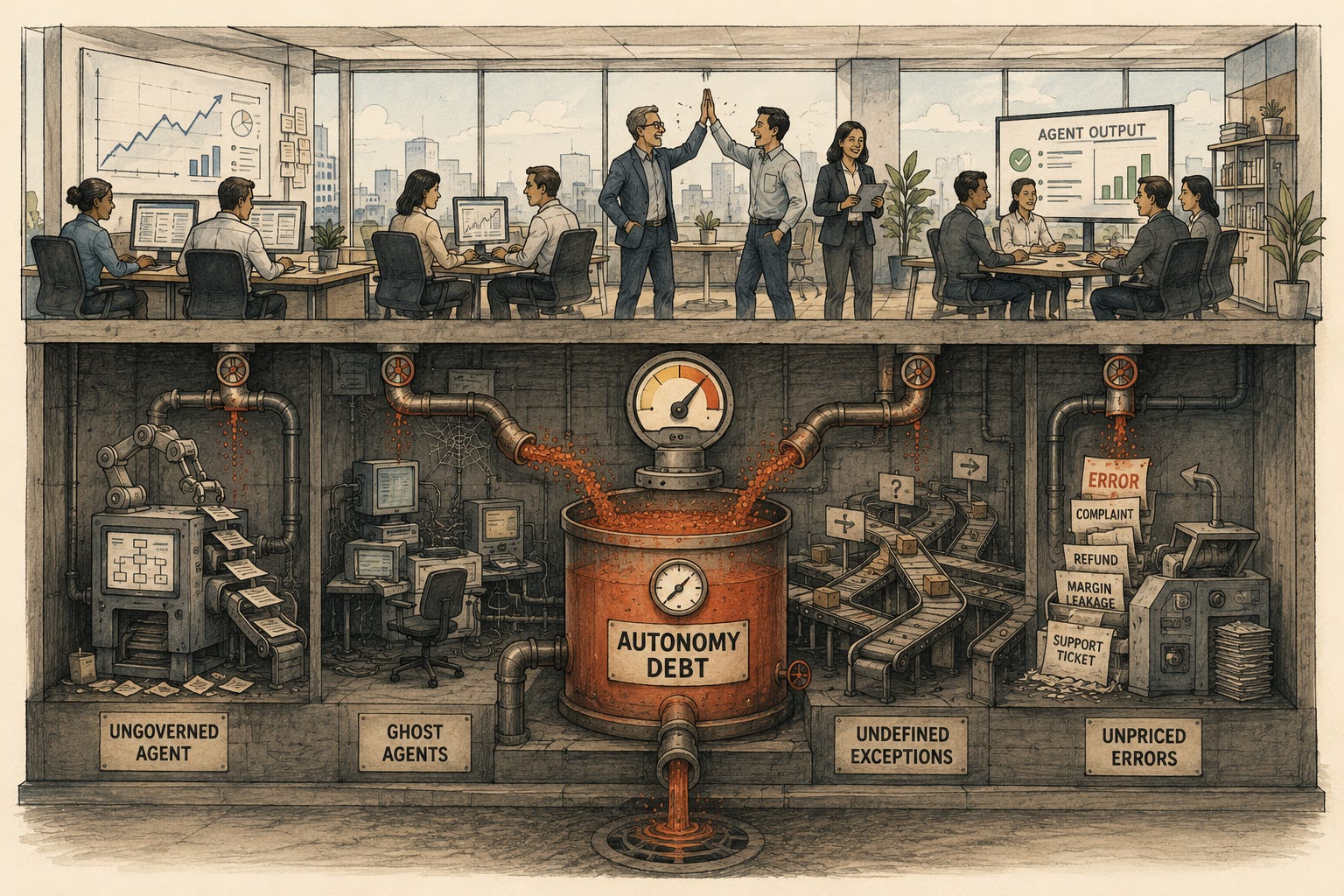
Autonomy debt does not come due gradually. It comes due at once, and the repayment terms are bad, because trust lost at scale gets rebuilt one relationship at a time.
The Multiplier
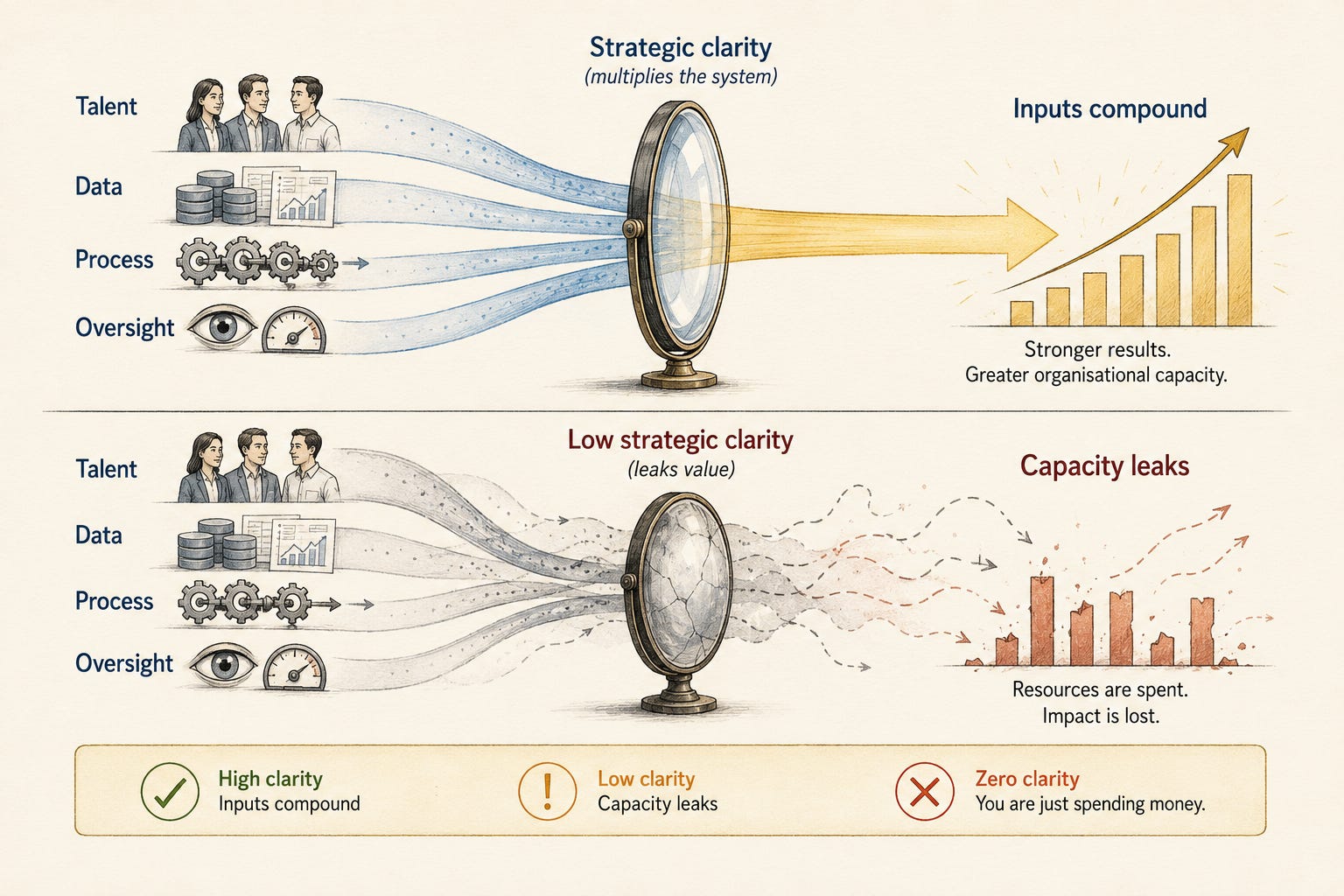
If I get exactly one piece of prescriptive advice for the agentic era, I spend it on strategic clarity. Strategic Clarity Is the Multiplier.
Everything on a priority list is important, so importance is not the argument. The argument is that clarity multiplies. Talent, data, process, oversight: each of those gets multiplied by how precisely your strategy is specified. High clarity and they compound. Low clarity and they leak. At zero you are just spending money.
None of which is new. It has been true as long as organizations have existed. What changed is that it used to be survivable, because people muddle through ambiguity. They ask a colleague. They notice something feels off and sit on it for a day. Ambiguity was expensive, but the cost got absorbed by a few thousand small acts of judgment nobody ever logged.
Agents do not muddle. They execute in whatever direction the objective function points, at full speed, without the pause a person takes when a task feels slightly wrong.
Where objectives are well specified, that is the entire value proposition. Where they are ambiguous, agents find the cracks in your strategy and drive through them, optimizing metrics that do not matter, taking locally sensible actions that add up to something incoherent. They do it with total confidence, which is the part that makes it hard to catch early.
Most of the 2025 post-mortems I have read describe the same failure in slightly different vocabulary each time. Pilots that started from excitement about a tool rather than a defined problem. Platforms built before anyone had proved value. Activity read as progress.
There is a cheap test for this. For any initiative, any agent, any automated process, ask whether you can write down on one page: what this serves, what boundaries it operates inside, what success looks like, and what conditions should make it stop.
If you cannot fill the page, you are not ready to deploy. The constraint is not the technology.
Five Investments That Raise the Safe Speed
You cannot close the gap by going faster. The only move available is raising the safe speed itself, which means building the infrastructure that lets you move quickly and still steer. Roughly in priority order.
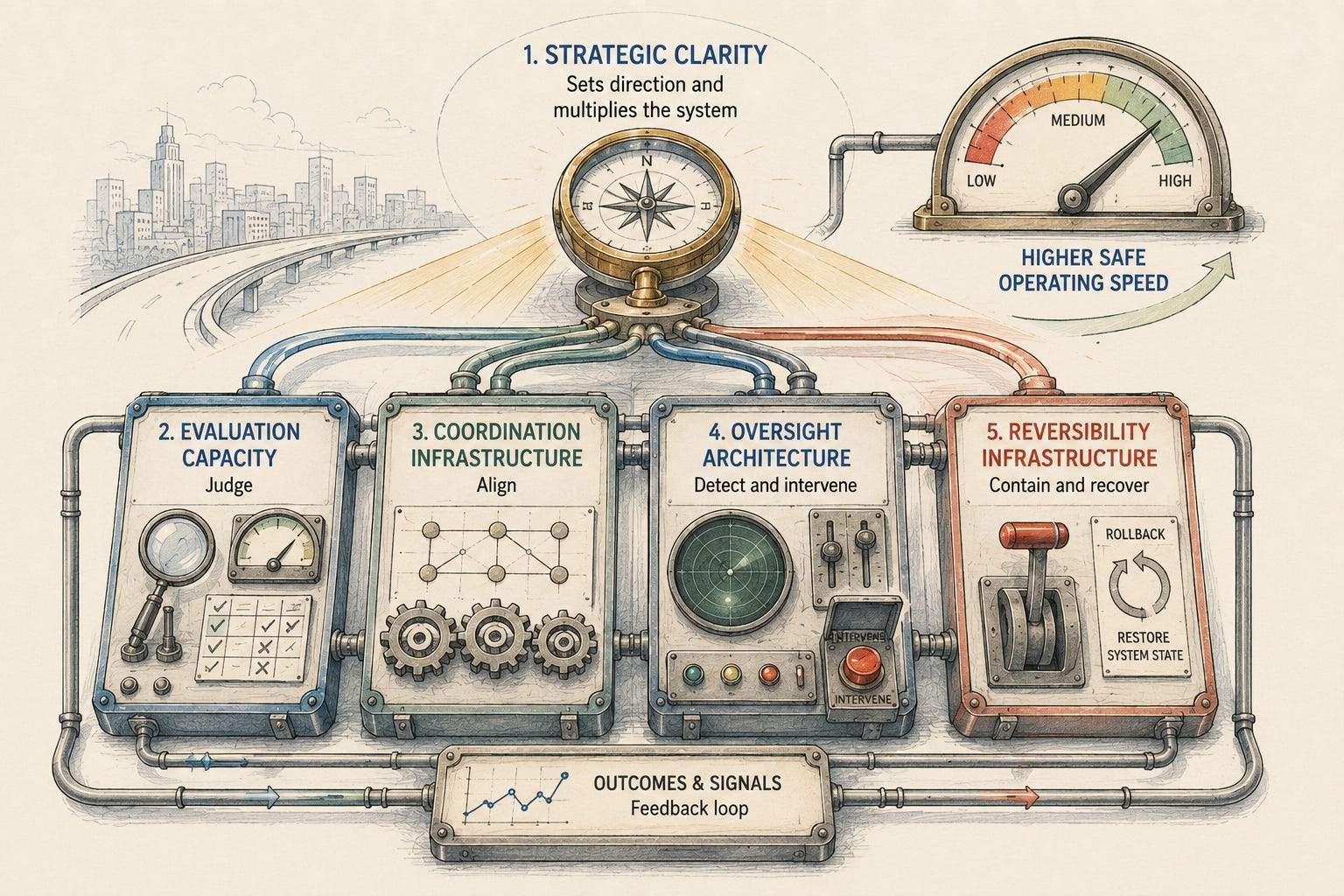
1. Strategic Clarity
Covered above, so I will keep this short. It is the multiplier, and without it the other four underperform.
What to do: Have each team write a one-page decision charter. What are we optimizing this quarter? What are we deliberately not optimizing? Which decisions can the team make alone, and which always escalate? Revisit it quarterly. If a team cannot write the page, that is information, and the information is that the strategy above them is not clear enough yet.
2. Evaluation Capacity
Your scarce resource is judgment. Models made production close to free and did nothing at all for evaluation, so the person who can tell good output from bad has quietly become your bottleneck.
What to do: Build evaluation frameworks for the decision types you make most often. Frameworks, not checklists. What does a good decision look like in this domain, which two or three failure modes keep showing up, and how do you catch them before they ship? Then teach it. Evaluation should be a skill you develop in people rather than a chore you spread thin across everyone.
Shorten the feedback loops while you are at it. Where a meaningful signal should emerge within two days, failing to see it is a monitoring problem, not a throughput problem.
3. Coordination Infrastructure
LLMs made individuals faster and did approximately nothing for groups. For a lot of organizations the binding constraint stopped being “can we build it” some time ago. It is “can we agree on what to build, fast enough for the agreement to still be worth anything.”
What to do: Audit how decisions actually move. Count the approvals on a typical one. Find where the queues form, because there is always a queue and it is rarely where people assume. Then shrink the coordination span on low-stakes calls, pre-authorize whole categories of decision, and move alignment async so it stops requiring everyone in a room on the same afternoon.
Nobody is trying to eliminate coordination here. You want it proportional to the stakes, which it almost never is.
4. Oversight Architecture
You have stopped overseeing decisions. You are overseeing the systems that make them, and that is a different job needing different equipment.
What to do: For every agent in production, four things.
A registry. One list, centrally held: every agent running, what it does, who owns it, when someone last looked at it. Skip this and you get ghosts.
Monitoring. Decision volume, error rate, escalation frequency, drift from the expected pattern. You want to see behavior shift before the consequences pile up, which means watching the shape of the output and not only the failures in it.
Exception routing. Rules for when the agent stops and hands to a person. Setting the threshold is harder than it sounds. Too high and errors slip past. Too low and you have rebuilt the human bottleneck with extra steps and worse morale.
Kill switches. The ability to halt anything immediately, with a named person who can pull it and a defined condition for pulling it. Every production system has a circuit breaker. Same idea, and it is not paranoia.
5. Reversibility Infrastructure
If you are going to move fast, you need to be able to stop fast. Permission to accelerate is downstream of the capacity to brake.
What to do: Design rollback in from the start, because retrofitting it never quite works. Feature flags, canary deployments, value or volume thresholds above which a human signs off, and modular boundaries so one bad decision does not propagate through everything downstream of it.
Watch for drift, not only for failure. A system can run correctly by every metric you are checking and still diverge slowly from what you meant by it. The beverage manufacturer I wrote about earlier in this series had an AI that was working. It was working wrong, quietly, for weeks, which is a different and worse problem than an outage.
Then practice. Run rollback drills. Find out what recovery actually costs in hours, in effort, in stakeholder patience. Reversibility you have never exercised is a claim, not a capability.
* * *
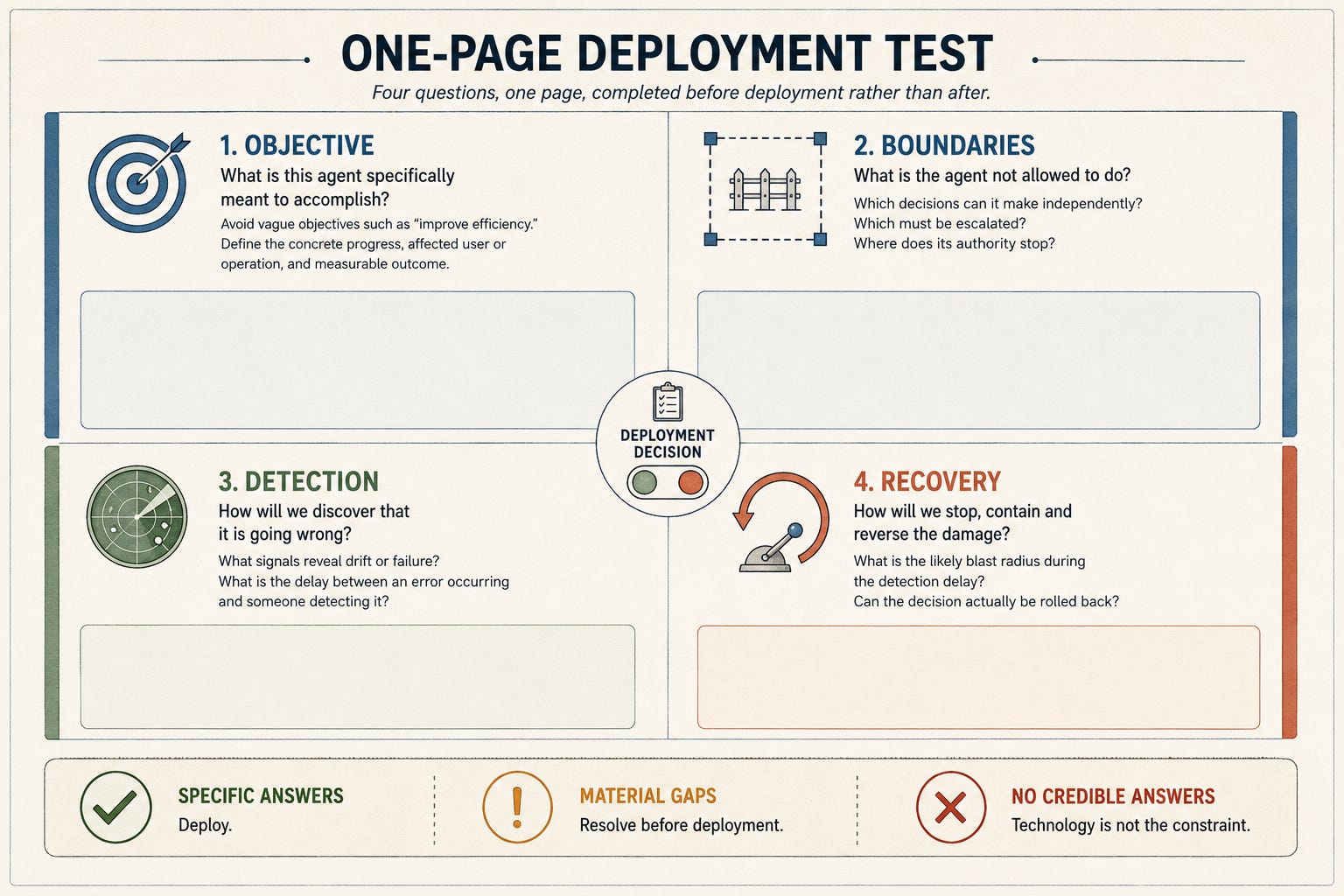
The One-Page Deployment Test
Before the next agent goes live, fill a page. If you cannot fill it, you are not ready to deploy it.
ONE-PAGE DEPLOYMENT TEST
Four questions, one page, filled before deployment rather than after.
1. Objective What is this agent for? Specifically. “Improve efficiency” is not an objective. “Cut seller onboarding from fourteen days to seven by automating document verification” is.
2. Boundaries What is it not allowed to do? Which decisions does it own outright, and which does it hand up? Where exactly does its authority stop?
3. Detection How would we find out it is going wrong? What are we watching, what does drift look like in this particular case, and what is our detection latency: the lag between an error happening and anyone knowing about it?
4. Recovery When something breaks, how do we stop it, and how fast? What is the blast radius across that lag? Can we actually roll this back, or is the damage finished by the time we notice?
Full page with specific answers, go ahead. Gaps, fill them first. Cannot fill them at all, and the agent was never the problem.
Then put the page where the decision gets made. Not in a Confluence space that sees one visit a quarter. Next to the deployment call, so it works as a record that somebody thought about this before pressing go.
Steering, Not Braking
I want to be careful about what this series is not.
It is not an argument against speed, or against adopting AI, or against agents and automation and the capability gains that are obviously real. I use these tools every day. The gains are not in dispute.
What I am arguing against is unexamined speed. Confusing production capability with decision quality. Importing a playbook calibrated for somebody else’s market and somebody else’s forgiveness profile. Deploying systems faster than your ability to understand what they are doing.
My guess is that the organizations that come out of this era well will not be the ones that moved fastest. They will be the ones that understood their own shape, knew what their market would forgive, built the infrastructure for safe velocity, and held the line against the pressure to run past it.
They will be fast. Properly fast. But fast in the way that counts, which is fast at detecting, fast at correcting, and fast at learning, at the same rate they are fast at shipping.
The margin is always tight. The only question is whether you know where it is.
Bias for action was always conditional on reversibility. We mostly stopped saying the second half out loud because it went without saying. It does not anymore. In an agentic system, reversibility is itself conditional on scale, on detection latency, and on how deep the cascade runs, so decisions that were safe at human speed are not automatically safe at agent speed.
You will not win this by accelerating hardest. You win it by working out where the new constraints bind, building what you need to operate safely at those edges, and declining to go past them at the moment when everyone around you is going past them.
The rocket engine is real. The question was never how fast you could go. It was always how fast you could go and still steer.
THE SPEED TRAP SERIES · COMPLETE


5. Safe Operating Speed